
Being Green

A post inspired by ‘Seeing Green: A Philadelphia Story‘ by Yeah, Another Blogger

Medieval Green Man

Our English word for the colour ‘green’ comes from the Old English word grene which has the same word root as that of the words grass and grow. It’s no surprise, then, that we associate green with nature and new life. Similarly, in the Middle Ages, the colour green – with its profuse representation in the natural world – was a potent symbol of the beauty of God’s creation. God’s promise of hope, fertility, and abundance was renewed each year as people witnessed the green shoots of Spring pushing through the cold, hard earth of Winter.

The great 12th century abbess and visionary, Hildegard of Bingen, seems to have had quite a fondness for the colour green. Firstly, there is her detailed knowledge of, and admiration for, the plants and herbs of her locality which she used in healing medicines and ointments for her nuns and others needing treatment. Then, there are the green-themed ‘upmarket’ remedies that Hildegard recommended: She regarded the emerald as the “jewel of jewels” for treating many ailments – heart and stomach problems, headaches, even epilepsy. The emerald’s efficacy was due to its excessive greenness which, for her and others of the time, signified that it had absorbed all the green goodness of the natural world as it sprang back to new life each Spring. The emerald was not necessarily ingested, however; just wearing it as a charm or drinking some wine in which it had been placed was considered effective. (No doubt many of us would agree that wearing an emerald might make us feel better!). Hildegard also evoked greenness in relation to spirituality. She used the word viriditas (from the Latin meaning ‘greeness’) to describe the vitality, verdant beauty, and potential for growth of the human soul.

Not everyone saw green as a positive force, however. Some medieval churchmen were wary of the colour precisely because of its association with the natural world. That is, some saw green as representative of the pre-Christian religions that worshipped nature, and found their meaning in the renewal and abundance that the seasons brought. The medieval ‘Green Man’, depicted with his face and head surrounded by foliage, is a motif often found carved into medieval (English) churches. His incorporation into Christianity points to the way that the Church often managed to ‘neutralise’ the power of the Old Religions by appropriating their symbols. Some scholars think that the rise – in literature if not in fact – of the legendary outlaw, Robin Hood (topic for a later post), and his distinctive green clothing, was associated with some people’s yearning for a return to the old forms of worship.

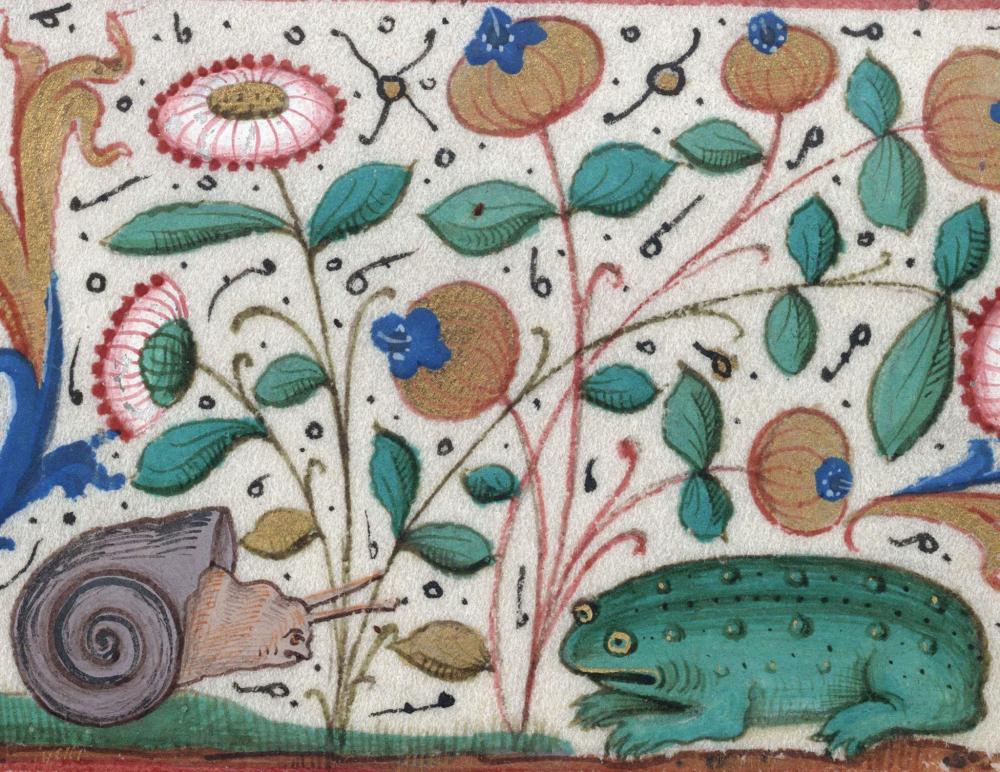
The beauty of the colour green, however, overshadowed the negative associations and it was a popular choice in the illuminated manuscripts of the time. But it was tricky to make. The naturally occurring earth and plant greens were not lightfast and so a mix of the more sturdy primary colours – yellow and blue – gave the best effect. Or, sometimes, verdigris – made from the blue-green rust of copper – was a good alternative but, again, the green colour thus-produced tended to darken over time.

Actually, it was not until the 18th century that a vivid green was produced; and, unfortunately, as it was made by mixing copper with arsenic, it was a dangerous hue, considered responsible for the deaths of many, possibly even Napoleon Bonaparte who had a penchant for green (arsenic-based) wallpaper in his palaces. It was not until the early 20th century that a vivid and safe green was produced. As that great philosopher Kermit the Frog so often said: “It’s not easy being green”.
Seeing Green: A Philadelphia Story

In addition to being a good read, this post represents a practical exercise in mindfulness and observation, I think. It’s inspired me to think about the many meanings of the colour Green in medieval times – the topic for my next post. Thanks Neil.

Yeah, Another Blogger's avatarYeah, Another Blogger

Last Saturday, one day prior to St. Patrick’s Day, I was itching to stretch my legs. The skies were clear, the temperature tolerable, and my schedule was open. A walk was in order. Where, though? My ultra-hilly suburban neighborhood? Nah. I’d made the rounds there on foot a few days earlier, huffing and puffing my ass off as I scaled the slopes. Yo, there’s a limit to the number of hills this old boy is going to attempt to conquer during any given week, you dig?

Anyway, I was in the mood for some liveliness. And because my area is not blessed with lively as its middle name, I decided to do what I’ve done a ton of times before: Board a train in my little town and allow it to transport me to the mostly flat City Of Brotherly Love. I stepped into the choo-choo at about 10:40 AM…

View original post 963 more words

Hard Labour

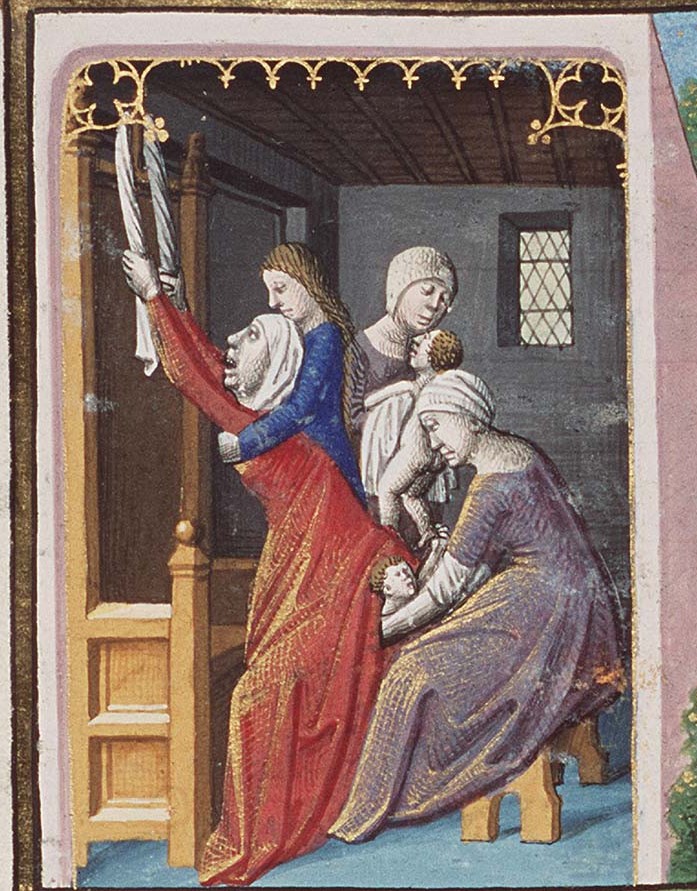
Giving birth in medieval times was a risky business – for mother as well as baby. While data from the era is scarce, a conservative estimate of maternal death (during the birth process or soon after, as a result of infection) was between 3% – 4% for each birth. And as women who survived the first birth would invariably go onto give birth again, and again, and again, the risk of death for any one woman was as high as 10%. Figures on infant mortality are even more scarce but estimates are put at between 30 – 50 %. (Such a figure may well include the death of infants due to infection in the first few weeks of life). It’s a grim picture and one that I had clearly in mind when I wrote about the birthing experience of one of the characters in my recent novel Grasping at Water (Odyssey Books, 2018). As some of you might know, the novel is set in modern-day Sydney and tells of the life-changing impact a mysterious young woman has on those with whom she comes in contact. The woman only reveals herself to others in medieval tales and the following is one such tale, an extract from the novel that I thought some of you might find interesting.

And then it is winter in the great town of Norwich in East Anglia. A bleak wind is blowing from the sea across the flat fenland, picking up cold moisture as it roars in, and dropping it as icy rain onto the town. In the town, the street that I see is not cobbled but is of packed-dirt and the freezing torrent has turned it to sticking mud. The surface gutters are clogged with putrefying waste, causing animal and human excrement to overflow and mix with the mud, all congealing into a sickly stew that coats traversers’ legs up to their knees in solid filth and fills their noses with a stench so vile that it liquefies in their lungs. Inside my house, a peat fire burns in the open hearth and warms the inhabitants but its smoke is thick, odorous and irritating. I am lying on a low settle bed in the corner of the dim, low-ceilinged room and I am coughing, the choking spasms adding to the severity of the pains of my labour that is now in its second day.  The blinding rain that has beset the town for three days has prevented the gathering and strewing of fresh rushes and fragrant herbs on the dirt floor of the lying-in room. No men are permitted near a birth but, nevertheless, I think of Hugh and long to see his face and have him touch my hand and kiss my mouth once more. He cannot. He is gone. Matilda, the midwife, and my mother attend me, tiredly but lovingly rubbing my belly and flanks with rose oil, and giving me a mixture of vinegar and sugar to drink. I am shivering with cold, with fear, with effort. Matilda unpins and loosens my hair, my mother opens a cupboard door and unties the knots in her apron cord so that the room is animated with opening and loosening in the hope that my laboring body will similarly slacken and open. Saint Margaret, the patron saint of childbirth, is invoked in fervent prayers. My pain increases, more slow hours pass, and still I labour without reward. Matilda and my mother speak to each other earnestly in whispers. A decoction of flaxseed and chickpeas is prepared and Matilda rubs this on her hands and then pushes her hands into me to rotate the baby who cannot find its way into the world because it is trying to enter feet-first. I am helped to the birthing chair and Matilda crouches between my shaking legs, easing, encouraging. My mother stands behind the chair, supporting me under my arms. I can barely stay upright let alone push so Matilda must pull. Amid screams and wails, a tiny, whimpering but beautiful boy is born.  I am cleaned and assisted back to the bed. He is bathed, rubbed with salt, warmly swaddled and placed on my breast. At first, his tiny, mewing mouth seeks nourishment but, like me, he is weak. I stroke his head, willing him to suck, but he does not. Such has been the stress of his arrival that he dies, pale and cold before he has had the chance to be pink and warm in my arms.

P
Life of Chaz

Books, games, music, and life — filtered through the mind of a writer, drummer, and philosopher who thinks too deeply about all of it. If it moves something in your chest, I'm interested.

Kangaroo Court of Australia

Why rent a lawyer when you can buy a judge

Dally Messenger III

Social Integrity - Civil Celebrants - Politics and Current Affairs

Quodcumque - Serious Christianity

“Whatever you do, do it with your whole heart.” ( Colossians 3: 23 ) - The blog of Father Richard Peers SMMS, Director of Education for the Diocese of Liverpool

On Research

Age Concern New Zealand

Notes from the U.K.

Exploring the spidery corners of a culture and the weird stuff that tourist brochures ignore.

Zombie Salmon (the Horror Continues)

A blog about Horror fiction, Horror writing, and Horror criticism...a continuation of The Horror at Open Salon

Causeway Lit

An online literary journal

From my Mind

From My Mind: You can call this site as a personal blog or personal dairy: whatever it's I wanna call this site as my World. Because here, I post whatever it reaches my mind.

SHINE OF A LUCID BEING

Astral Lucid Music - Philosophy On Life, The Universe And Everything...

David Palethorpe

The thoughts, dreams and ideas of an insignificant speck of humanity in the Universe 😀

Ailish Sinclair

Stories and photos from Scotland

Unsophisticated Articles

A learning tool through experience

wake up and smell the humans

The website of Sean Crawley

GWEN WILSON The Reluctant Retiree

Stories from Garrulous Gwendoline - a baby boomer surviving retirement

The Immortal Jukebox

A Blog about Music and Popular Culture