
Mirror, Mirror!

mirror

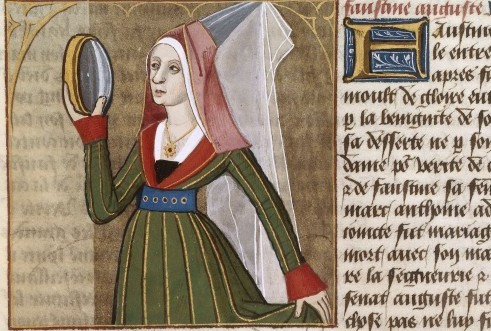
We all remember the magic mirror belonging to the evil queen in the fairytale, Snow White. Each day the queen would position herself in front of the mirror and ask, “Mirror, mirror, on the wall, who is the fairest of us all?” And the mirror would reply, “You are, O Queen.” The queen would be reassured for the moment, content in the mirror’s lie and its acquiescence to her vanity.

                Throughout history, the mirror has been one of the most prevalent and potent metaphors for the folly of human vanity. One of the foundational Western myths, for example, is the story of Narcissus who fell helplessly in love with himself when he discovered his reflection in a woodland pond. So taken was he with the beauty of his own image, he could not leave the pond and so died there.

Today we, too, seem to be obsessed with our own images. We wouldn’t think of leaving the house without first checking ourselves in the mirror. Lifts in buildings have mirrored walls so we can pass the time by looking at ourselves as we ascend or descend. There are mirror apps for our phones. And our mobile phones are the new mirrors, providing us with the instant ‘selfies’ that we can enhance (or delete) before sharing them with the world.  We spend countless billions on lotions and potions in attempts to beautify ourselves and to ward off the aging process. Beauty and youth are idealized and idolised in glossy magazines, on the big and small screen, and across social media. And the way to happiness is often touted as being as easy as a few deft swipes of the plastic surgeon’s knife. The idea is that we’re only as worthwhile as our outward appearance. If we don’t look good, we cannot be happy. In this way, the mirror is powerful because we allow it to have power.

And its power over humans started a long time ago. Archaeologists have found evidence of the earliest mirrors being simply polished surfaces of natural materials – rocks like obsidian, for example – which could reflect back an image, albeit a hazy one. With time, the crafting of metals – copper, silver, gold – gave the self-viewer a slightly clearer idea of him/herself but it was still a rudimentary reflection. The glass mirror – the closest ancestor of our contemporary mirrors – is recorded from Roman times but it was really during the Middle Ages that the quality of glass became good enough to return a clear reflection. Around that time, the manufacture of a much smoother glass enabled a relatively blur-free surface to be achieved and its reflective ability was increased by backing the glass with a metal such as gold leaf or a silver-mercury combination.

The medieval mirror par excellence was the work of Venetian glassmakers on the island of Murano. Their backing material of choice was kept secret for many decades but it was known to include mercury in the gilding process which, of course, made the final product ‘problematic’. Still, that didn’t dampen the general enthusiasm for mirrors (though, of course, their cost made them a luxury item for the wealthy only). After that, the reflective quality continued to improve over the centuries as production methods advanced the clarity of glass.

As far as the mirror was concerned, there was no looking back!

Author! Author!

venerableBede - Copy

I must confess that I’ve always had quite a bit of sympathy for the biblical ‘Doubting Thomas’.** It seems such a very human reaction to me to express incredulity at a man rising from the dead and to want to verify the event by reliance on one’s own senses. We doubt many things that we haven’t seen with our own eyes or perceived with our other senses. We are a society that demands proof as a matter of course. Business cannot function without written contracts; academic research builds on earlier (written) research results; the legal system insists on proof before a conviction can be recorded. We wouldn’t dream of taking a financial institution’s word as to our account balance – we must check the statement ourselves. MRIs and other technologically complex tests are necessary to probe and verify our illnesses. We cannot leave the country without a passport; nor can we be considered to even ‘exist’ without a birth certificate; and we’re only officially ‘dead’ when the Death Certificate is entered into the public record.

This wasn’t always the case. The Venerable Bede, for example, completed the writing of his Ecclesiastical History of the English People in 731. Bede was born in Northumbria in about 673 AD. At the age of seven he was given by his parents into the care of the Benedictines at the monastery of Saint Peter in Wearmouth in north-east England. In 682, Bede was transferred to a joint-foundation at Jarrow and there he remained as a monk until his death in 735. In the Preface to his history, Bede assures his readers that they can trust in all that he has written because, he states, “I am not dependent on any one person, but on countless faithful witnesses who either know or remember the facts”. That is, for Bede, the authenticity of his history comes not only from earlier written accounts but also from a variety of trusted oral and traditional sources. It is Bede’s words, and the words of those he trusted, that are presented as the impeccable credentials on which the veracity of his work rests.

In the High Middle Ages, too, the importance of trusting the words (written and spoken) of others found full realisation in the writing practice of NOT being seen to be original and creative but, rather, of being regarded as giving due acknowledgment to those who had gone before, of building on the firm foundations of the insights and achievements of previous generations. Bernard of Chartres’ saying (often incorrectly attributed as having its origin with Isaac Newton – though Mr Newton certainly said those words too), “We are as dwarves on giants’ shoulders …” is emblematic of the time which gave us the word ‘author’ from the Latin ‘auctoritas’ meaning ‘authority’. That is not to suggest, of course, that the great medieval writers were not creative; in fact, authors such as Geoffrey Chaucer and Marie de France (more of these in later posts) turned narrative conventions upside down to give us stories that are as fresh and relevant today as they were at their time of composition. And nor is it to suggest that the writings of the past centuries were all ‘true’ and utterly ‘honest’ representations of people’s lives and thoughts. The art of Rhetoric has been around since at least the days of the Ancient Greeks and part of the ‘authority’ that was passed on from them to the Western authors of the early and later Middle Ages was the insight that words are slippery, and can exert influence, menace, confusion as well as relay information and inspiration. 

The situation is no different today. So, what to do? The doubt of Thomas, the trust of Bede, the creative slipperiness of Chaucer? As a writer I’m opting for the third option; but in my everyday life I’m taking the middle ground: open mind and open heart with the occasional pinch of scepticism.


**Thomas, called the Twin, who was one of the Twelve, was not with them when Jesus came. When the disciples said, “we have seen the Lord”, he answered, “Unless I see the holes that the nails made in his hands and can put my finger into the holes they made, and unless I can put my hand into his side, I refuse to believe” (John 20: 24-29).

Le cantique de Frère #Soleil

In my recent post I’ve written about St Francis of Assisi, his love for all creation, and his beautiful Canticle of Creatures, also known as Canticle of the Sun. This lovely post by Lunesoleil is also about the Canticle, and from a different perspective.

Lunesoleil's avatarL'actualité de Lunesoleil

saint-francoisSaint François d’Assise 

En ce jour de Dimanche  dédié au Soleil 🌞

Très haut, tout puissant et bon Seigneur,
à toi louange, gloire, honneur,
et toute bénédiction ;
à toi seul ils conviennent, ô Très-Haut,
et nul homme n’est digne de te nommer.
Loué sois-tu, mon Seigneur, avec toutes tes créatures,
spécialement messire frère Soleil.
par qui tu nous donnes le jour, la lumière :
il est beau, rayonnant d’une grande splendeur,
et de toi, le Très-Haut, il nous offre le symbole.
Loué sois-tu, mon Seigneur, pour soeur Lune et les étoiles :
dans le ciel tu les as formées,
claires, précieuses et belles.
Loué sois-tu, mon Seigneur, pour frère Vent,
et pour l’air et pour les nuages,
pour l’azur calme et tous les temps :
grâce à eux tu maintiens en vie toutes les créatures.
Loué sois-tu, mon Seigneur, pour soeur Eau.
qui est très utile et très humble,

View original post 122 more words

Playing Chicken

Chickens

My neighbours have built a chicken coop (‘a chook shed’ as we Aussies say) in their suburban backyard with high hopes of having fresh eggs for breakfast for many years to come. It’s a good plan and one to which people the world over have subscribed for many, many centuries. Today’s domesticated chickens are, apparently, descended from the Red Jungle Fowl of South Asia. The Romans are thought to have brought chickens to Britain with them and it’s the descendants of that Roman poultry that have become the focus of some intense archaeological studies in the past few years. What particularly drew the archaeologists’ attention was the discovery of substantial increases in the quantity of chicken remains that could be dated between the 9th and 12th centuries. Though chickens had been an easy and popular feature of even the humblest farms prior to, and following those centuries, several studies noted that the 9th – 12th century increase correlated with a surge and expansion of the farming and fasting practices of the Benedictine monks: they abstained from the eating of meat from quadrupeds but, as birds (and their eggs) were not considered to be ‘meat’ – having only two legs –  the raising of chickens on their monastery lands was a good way of feeding the monks and honouring their fasting obligations. The spread and influence of the Benedictines in these centuries very soon saw their fasting practices adopted by large portions of Christian society. A simple case of chicken and egg.

It got me thinking about a chicken and egg experience of my own.

One year, in an effort to give our city-born-and-bred daughters a taste of ‘rural life’, we hired a farmhouse cottage for the July school holidays. The cottage was ‘rustic’ to say the least, with bare, unsealed floors, lumpy beds and no heating except for a wood-burning stove in the little living room. This left the kitchen and bedrooms bitterly cold in the Oberon winter. Still, we reasoned that frosty breath in the morning, and icicles on the windows were part of the adventure. A blanket of snow in the surrounding yard was also a bonus. In the yard, too, much to the delight of three little girls, was a chicken coop with one – and only one – fat, red hen. The farmer, greeting us on our arrival, told the children that the hen’s name was ‘Henrietta’ and, pointing them to a bag of chicken feed, he said that they could feed her each morning and evening. They were beside themselves with joy and, as soon as the farmer took his leave, they were in the coop with Henrietta.

“Be gentle with her,” I instructed.

“We will, Mummy, but we just love her. Do you think she’ll lay some eggs?”

“Well, I certainly hope so,” I replied. “That’s what hens do.” What I, as a city-born-and-bred mother did not know, however, was that chickens don’t lay very reliably when the mercury is sitting below freezing most of the day and night.

Now, whether it was indeed the freezing weather, or the hen’s nervousness at being so greatly loved by three little girls, the first week passed without my daughters discovering a single egg in Henrietta’s coop.

“Mumma, you said she’d lay eggs,” they moaned as they tramped despondently back into the cottage empty-handed again.

Our days at the farm were ticking by and, with only four mornings left, I decided to take the egg production business into my own hands. After the girls were asleep that night, I crept out to the chicken coup with a torch in one hand, and a fine, brown egg from a carton purchased at the local supermarket in the other, and I carefully placed the egg next to a somewhat alarmed chook.

The next morning the girls made their way doggedly to the hen-house, mumbling that it would be another waste of time. I smiled quietly to myself as I heard their excited cries.

“Mummy, Mummy, look. Come quickly,” they shouted.

I ran out, arranging a fake look of surprise on my face as I went, but my pretence turned to real surprise when the girls stood in front of me with an egg each in their hands.

“Mummy, Henrietta’s laid three eggs,” they said, proudly holding up their discoveries for my inspection. There, in front of my eyes, were three brown eggs – and only one of them was store-bought.

Over the remaining days of our farm stay Henrietta managed to produce two eggs each morning, without any prompting from me and, nearly twenty years on, Henrietta lives on in the memories of my daughters – and of me, especially – as a chook who could take a hint. Like most of us, all she needed was a little encouragement.

Let’s Dance

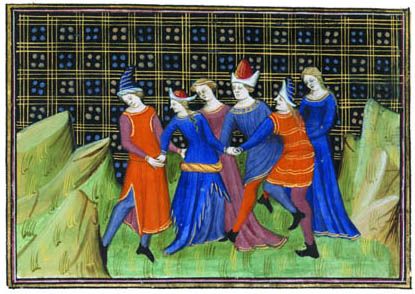
medieval dance


Some of you who have followed my blog for a while will know that the subject of my PhD thesis (over 18 years ago now) was, broadly, medieval mystics; and every now and then (well, quite often, actually) I am drawn back to their beautiful writings for inspiration. I am in one of those ‘phases’ currently so there might be a few ‘mystical’ posts making an appearance over the coming weeks. Today, I needed to reflect on one of my ‘favourites’ – the brilliant Mechtild of Magdeburg. Here she is:

Mechtild of Magdeburg was a medieval mystic whose visions and insights ranged, quite literally, from the depths of hell to the heights of heaven. She was born in Saxony in about 1210 and, from evidence within her own writings, seems to have experienced her first visions at the age of twelve. At about the age of twenty she left her home to become a Beguine[1] in the town of Magdeburg. There, under the spiritual guidance of the Dominicans, Mechtild’s visions continued and increased and she was encouraged to write them down. This she did in a text under the title of The Flowing Light of Godhead. However, Mechtild’s claim that God had directed her to record these insights and experiences attracted considerable suspicion and criticism, and this increased when, in turn, Mechtild voiced her own criticism of certain local and high-ranking clergy. As a result, for her own protection, in 1270, Mechtild was moved to the Cistercian convent of Helfta. There, in the company of other great mystics of the time, including Mechtilde of Hackeborn and St. Gertrude the Great, Mechtild passed the final years of her life, in writing and in prayer, until her death sometime between 1282 and 1290.

Mechtild’s writings are representative of the ‘affective’ or via affirmativa approach to mysticism in which the mystical experiences are recorded and conveyed in a language that is steeped in metaphor, analogy and sensual imagery. There is no doubt that Mechtild was a gifted poet and some scholars have, rightly, speculated on how much of her writing is attributable to actual mystical inspiration and how much to pure poetic expression. Her visions of hell and purgatory and heaven, in particular, are graphic enough to have prompted comparisons with Dante’s Divine Comedy, particularly as Mechtild’s version features descriptions of deeper and deeper levels of hell and purgatory where souls are tormented according to the severity of their sins. Some have even suggested that Mechtild’s descriptions were Dante’s inspiration and that Mechtild herself is represented in the poem as the character, Matelda. Such comparisons remind us that the ‘affective’ medieval mystics used not only beautiful imagery that elevates and delights the modern reader but also, sometimes, gritty and confronting imagery that challenges our modern sensibilities. Perhaps it is the ‘dance’ of these opposites that is one of the reasons that the mystics retain an appeal for us today. We, too, must live in a world that is often ugly and fraught with despair; but we also have the promise and knowledge of the great beauty of creation, and the undercurrent of something divine, mysterious and constant that somehow sustains and enlivens us. Perhaps ironically, then, the poem that is now most synonymous with Mechtild is about ‘the dance’ but, in this case, a very positive and beautiful dance with Divine Life.

I cannot dance, Lord, unless you lead me.
If you want me to leap with abandon,
You must intone the song.
Then I shall leap into love,
From love into knowledge,
From knowledge into enjoyment,
And from enjoyment beyond all human sensations.
There I want to remain, yet want also to circle higher still.        

(Mechtild of Magdeburg)

[1] A beguine was a woman who lived a life dedicated to God but who did not take the vows of religiously professed women. Instead, she lived with other similarly dedicated women who often worked in the community but returned to the “group house” (beguinage) to share in a community life of prayer. Topic for another blog.

Raising Specks to the Spectacular

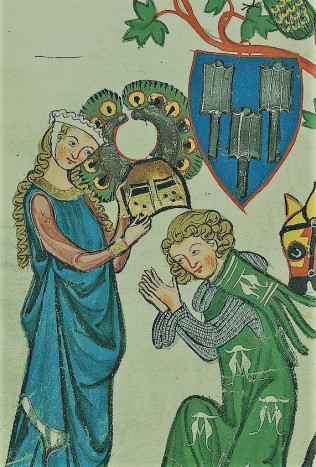
Meister_der_Manessischen_Liederhandschrift_001

O the dignity of that small speck of human dust
Taken by the jewel of heavenly excellence

To raise us from the clay of earth to heaven’s height
                                        (Gertrude the Great 1256-1302)

Gertrude the Great was a nun and mystic in the great Benedictine abbey of Helfta in Saxony. There she was one of a group of medieval women who later came to be known as “the scholars of Helfta” because of their extraordinary writings and mystical experiences. Gertrude’s prayer brings together two paradoxical aspects of our human existence – our insignificance in the grand scheme of things, and our dignity. Her lovely metaphor for each of us as “that small speck of human dust” is even more relevant today than it was when Gertrude composed her poem in the late 13th century.

Last time I checked, the world’s current population is around 7.5 billion people, and increasing at a rate of about 3 people per second. In the (population) scheme of things, a human individual is very insignificant indeed. And if that isn’t sobering enough, consider the fact that our Sun is only one of billions of stars in billions of galaxies in the universe. The total number of stars is calculated to be greater than all the grains of sand on Earth. Our Milky Way galaxy alone has about 400 billion stars. In effect, we’re a speck on a speck (Earth) in a spectacularly vast universe.

The 14th century English woman, Julian of Norwich (another great mystic), was also given a view of Earth’s smallness and insignificance in one of her (what she termed ) “Revelations of Divine Love”. In her writings on those profound revelations she explains that she was shown “a little thing, the size of a hazel nut, lying in the palm of my hand”. As she looked at it, she wondered what it could be and she was answered that “It is all that is made”. Julian admits that she was amazed that all of creation was so inconsequential and she was anxious about having the responsibility of holding it in her hand because she thought that “it might suddenly have fallen into nothingness because it was so little”. Julian’s anxiety was soothed when she was told that creation endures, and will continue to endure, because God loves it. It is a simple statement and yet it’s possibly the only answer that makes any sense to us: love endures.

We cannot hope to truly comprehend the vastness and complexity of our universe but we can understand, from our own everyday human experience, what it is to be loved and to love ourselves and others. Of course, to truly love others we must acknowledge their humanness – the positive and negative attributes of the personality, the annoying habits, the inconsistencies, the humour and kindness, the bad temper, the fears, the thoughtfulness, the failings as well as the successes. In our enduring love for others, we raise them up in our own estimation and, as a consequence, they are also raised in their own view  – from specks to spectacular. So, like Gertrude the Great, Joe Cocker was onto something in his song “Love Lifts us up Where We Belong”.


A Vine in Winter

vine in winter

The wisteria vine that surrounds my home’s back deck is smooth and bare right now.  Looking at it, I find it hard to imagine the shock of white blooms that will burst forth from it in Spring, and then the lush green foliage that will completely cover the bareness in Summer. The renowned early 20th century writer and researcher into mysticism and mystics, Evelyn Underhill, defines mysticism –  in its simplest terms – as “seeing things differently” and I often remember that little definition when I look at my wisteria vine. Beneath its nakedness the vine is full of life, full of potential, that will flower when the conditions are right.  Great thinkers throughout history have dared to see things differently. Sometimes, they have had to wait a long time to be vindicated. Galileo is a good example. He dared to see the medieval cosmos in a very different way, going so far as asserting that, contrary to the firmly held view of the time, the Earth revolved around the Sun and not vice versa. Persecuted by the Inquisition for his views, he was finally exonerated in 1992 when Pope John Paul II officially declared that Galileo had been correct all along.

The medieval view of cosmology basically rested on the theories of Ptolemy and Aristotle.  In this view the Earth was at the centre and was surrounded by the seven progressively larger concentric spheres of the Moon, Mercury, Venus, the Sun, Mars, Jupiter and Saturn. (And, by the way, this is where we get our expression, “in 7th heaven”). Beyond the planetary spheres were, firstly, the stellatum – the area of fixed stars – and then the primum mobile which was the boundary of the physical universe. In the medieval, Christianised version of cosmology, beyond this outermost sphere (and thus, literally outside the universe) was the Empyrean or Heaven, the place of God.

Of course, we are very unlikely to have the visionary and intellectual insights of Galileo but we can at least try to be more open in our approach to life. We can strive to “see things differently” by, in particular, accepting others’ points of view; we can try to step outside our comfort zones and reach out to people whom we might ordinarily avoid; we can embrace some new ideas and new technologies and see them as opportunities rather than threats. We can choose to grow rather than to stagnate and, then, to let our potential flower when the time is right. And, with any luck, we won’t have to wait as long as Galileo to harvest the fruits of our “new view”.

Heaven S(c)ent

distillingperfume

Fine perfume is, and always has been, a luxury item, its high price putting it out of reach of many people in poorer social circumstances. But, in the Middle Ages, perfume was not only an indicator of high social status but a necessity for anyone who could afford it.

The streets and winding laneways of medieval towns were awash with dirt and foul-smelling waste products (of the animal, vegetable, and human kind), the limited lighting in most houses was by means of tallow candles which smoked and gave off a rancid odour, and the tightly-packed and poorly ventilated houses were musty. Scented oils in the dwellings and/or on the person provided a welcome relief from the daily assault on the olfactory senses of all. And it was believed that sweet fragrances warded off malodorous evil spirits. The pomander ball – a sort of spherical vase or container, or sometimes a bag filled with fragrant herbs – enabled individuals to carry a pleasant smell around with them, dispelling bad smells and (it was thought) evil infections in their wake.

At that time, perfumes were prepared by infusing oils (usually almond or olive) with flowers such as rose, lavender and violet, or with other readily available plants like lemon, and herbs such as thyme and sage. Resins helped fix the scent and, later, when the process of distillation was perfected, the production of perfume became more widespread and of a more commercial concern, expanding access to this important item.

Patrick Suskind’s novel Perfume: The Story of a Murderer (1985) gives some wonderful details of the processes involved in creating special perfumes while, at the same time, offering a disturbing story about the evocative and provocative powers of scents and the sense of smell. Not a read for the faint-hearted (you might need your pomander ball close-by!).

Lions, and Dragons and Beasts, Oh My!

lion_bestiary

In the Middle Ages, the understanding of the natural world was not based on scientific observation but on utility and moral applicability. This was particularly so for plants and animals: if they could be eaten (or could produce eggs, milk etc for human consumption) then they fitted into the scheme of things and were farmed or domesticated accordingly. However, many plants and animals defied ready explanation and represented, instead, a source of such wonder and (often) fear that their very existence could only be accommodated if they were regarded as serving a moral purpose. Enter the bestiary, a book that was a sort of compendium of beasts and animals, real and mythical, accompanied by a symbolic interpretation and a moral lesson, particular to each beast.

Although the bestiary had originated in the ancient world (with the volume known as Physiologus bringing together insights about animals from such authors as Aristotle and Herodotus), it was later Christian writers like Isidore of Seville and St Ambrose who gave the stories a moral and religious focus. Because the majority of the medieval populace was illiterate, the imparting of the Christian message in stories and allegories was an essential part of the Church’s teaching method. Nevertheless, the creatures presented in the medieval bestiaries were usually so exotic that their descriptions were often considered to be factual in many respects. Griffins, dragons, and unicorns featured along with lions and elephants.

Even in early times, the lion was considered to be the king of the beasts, and as such, generally is the first beast described in the bestiaries. Two types of lions are described: a timid lion which has a short body and curly hair (think, the Cowardly Lion in L. Frank Baum’s The Wizard of Oz); and a fierce lion with a longer body and straight hair. Both types were understood to have three particular attributes: the practice of erasing their tracks with their tail; always sleeping with eyes open; and giving birth to dead cubs which the mother brings to life on the third day by breathing into them.

The Christian association of Jesus with the lion is relatively straightforward: the lion as King of the Beasts = Jesus Christ the King. (In this aspect, such writers as C.S. Lewis with his character Aslan in The Lion, the Witch and the Wardrobe can be seen to be drawing directly on the medieval parallel). And the three attributes are similarly associated: the lion’s erasing of its tracks was representative of Jesus’s hidden divinity; its sleeping with eyes open represented Jesus’s (and all Christians) physical death to the world but spiritually alive and alert; and the lion cubs being brought to life after three days is, of course, allegorically standing for Jesus’s death and three days in his tomb before his resurrection.

The bestiaries’ lion could be injured by a scorpion but it was only serpents that could kill it. And supreme among the serpents was the dragon, with its strength in its tail and not its teeth. Its thrashing, coiling tail enabled it to kill any animal – even one as large as the elephant – by suffocation. Thus, the dragon stood for the Devil, with his ability to squeeze the (holy) breath of life out of souls, suffocating them with sin. Further, with his fiery breath, the dragon could make the air shine and so he would sometimes appear to be an angel of light, tricking and luring the unsuspecting to their spiritual demise.

The dragons of today’s literature (for children in particular) are generally quite placid, with their mythic quality overtaking their earlier ‘evil’ connotations. dragon
I have a harmless dragon, myself, in my garden.


(Well, I hope he’s harmless!).


A Good Old-Fashioned Barber

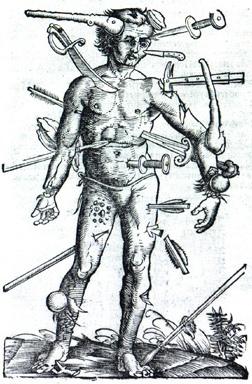
Wound_Man
A medieval Wound Man


In last week’s post I looked at the handy medieval medical guide for aligning bodily weaknesses with astrological influences as represented in “Zodiac Man”. The “Wound Man” served a similar purpose in that he was a visual compendium for the sorts of traumatic injuries that medieval surgeons might have to treat.

The medieval surgeon was not, of course, anything like the surgeon of our modern world. In fact, the medieval surgeon was often the local barber because one of the main criterion for “entry” to the profession was to be good with a knife or other blade. A barber had ready access, too, to these blades and plenty of practice and skill in using them on the human body.

The barbers’ poles of today, with their red and white intermingling spirals, are direct reminders of the dual skills of the barber of previous days. Originally the red represented the blood that the barber would draw from the patient either as a direct result of the surgery or as a deliberate outcome of bloodletting. This was a common medieval practice which involved the cutting open of a vein to allow the release of what was regarded as “excess blood” in the bodily humours. The pole’s white-coloured spirals, then, stood for the bandages that were applied to stem the wound at the conclusion of the “treatment”.

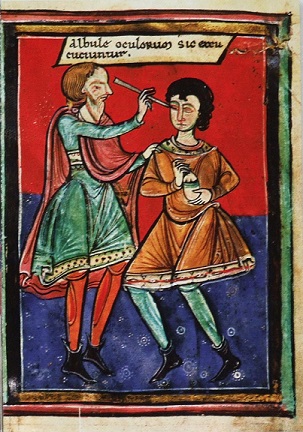
In the days before anaesthetic, surgery required a steady hand and it was not unusual that the surgeon was a woman. Her more delicate hands made the removal of anything from haemorrhoids to cataracts seem a little more bearable to the hapless patient.

cataract surgery
Medieval surgery for cataract removal

Something to think about next time you’re at the hairdresser.

Kangaroo Court of Australia

Why rent a lawyer when you can buy a judge

Dally Messenger III

Social Integrity - Civil Celebrants - Politics and Current Affairs

Quodcumque - Serious Christianity

“Whatever you do, do it with your whole heart.” ( Colossians 3: 23 ) - The blog of Father Richard Peers SMMS, Director of Education for the Diocese of Liverpool

On Research

Age Concern New Zealand

Notes from the U.K.

Exploring the spidery corners of a culture and the weird stuff that tourist brochures ignore.

Zombie Salmon (the Horror Continues)

A blog about Horror fiction, Horror writing, and Horror criticism...a continuation of The Horror at Open Salon

Causeway Lit

An online literary journal

From my Mind

From My Mind: You can call this site as a personal blog or personal dairy: whatever it's I wanna call this site as my World. Because here, I post whatever it reaches my mind.

SHINE OF A LUCID BEING

Astral Lucid Music - Philosophy On Life, The Universe And Everything...

David Palethorpe

The thoughts, dreams and ideas of an insignificant speck of humanity in the Universe 😀

Ailish Sinclair

Stories and photos from Scotland

Unsophisticated Articles

A learning tool through experience

wake up and smell the humans

The website of Sean Crawley

The Reluctant Retiree

Stories from Garrulous Gwendoline - a baby boomer surviving retirement

The Immortal Jukebox

A Blog about Music and Popular Culture

KAGHAMAR

L'art de la Bible