
Valentine’s Day: Love and Pain etc

Ah, Valentine’s Day. Love it, hate it, or ignore it, it rolls around every year regardless. And while the commercial aspect of Valentine’s Day is very much a modern phenomenon, the day itself has its origins in the Middle Ages.

True, very early foundations for the day can be found in the ancient Roman fertility Feast of Lupercalia which randomly paired young boys and girls in marriage; but it was the later Middle Ages (12th – 14th century) that gave us our current focus on romantic love. At that time, the West experienced a surge of interest in saints’ and martyrs’ legends. One very popular story was that of St Valentine, a priest of the 3rd century who defied the Roman Emperor Claudius II’s ban on the marrying of Christian couples, and proceeded to perform marriages in secret. For his efforts, St Valentine was executed in 278AD and his feast day came to be celebrated on 14th February.  

As it happened, too, the medieval people (particularly of France and England) commonly believed that birds began their mating season on 14th February. In his Parlement of Foules (Parliament of Fowls) the great Geoffrey Chaucer recorded the belief for posterity with the words:

For this was sent on Seynt Valentyne’s day 
Whan every foul cometh ther to choose his mate

The interest in romantic love had started to establish its presence in the medieval world around the 12th century when prominent people (such as Eleanor of Aquitaine) in European royalty welcomed troubadours and their love songs into courtly society. Before long, life began to imitate art with knights vowing their allegiances to courtly ladies (married as well as unmarried). This courtly involvement is where we get our word (and idea) of ’courtesy’ from. Of course, if the lady rejected the knight’s offer of allegiance, the medieval ‘rules’ of courtly love decreed that the knight would suffer great anguish and pain – the original ‘love sickness’.

Many of the love poems of the Middle Ages express this anguish. The following, again by Chaucer (here in translation from the Middle English), is a great example.

Rondel of Merciless Beauty

Your two great eyes will slay me suddenly;
Their beauty shakes me who was once serene;
Straight through my heart the wound is quick and keen. 

Only your word will heal the injury
To my hurt heart, while yet the wound is clean –
Your two great eyes will slay me suddenly;
Their beauty shakes me who was once serene. 

Upon my word, I tell you faithfully
Through life and after death you are my queen;
For with my death the whole truth shall be seen.
Your two great eyes will slay me suddenly;
Their beauty shakes me who was once serene;
Straight through my heart the wound is quick and keen. 

The juxtaposing of love and pain was common in medieval poetry; and today we find that same blend in poetry, literature and films. Such pairing is, of course, the natural expression of the human experience of love and loss but, today, the pain is regarded as coming more at the end of a relationship than at the beginning. In the Middle Ages, and following the much earlier Roman mythological view,  Cupid (and his mother Venus) were presented as the initiators of love (and lust). Cupid would aim his bow and shoot an arrow not into the heart of the soon-to-be-lover but into his eye; that is, the object of his admiration was first pleasing to the eye (in a “love at first sight” way). After that, the heart, and the will, would acquiesce and act on the desire. You’ll notice that Chaucer plays with this “eye-heart” connection throughout the Merciless Beauty poem, and he also highlights the “wounding” and “slaying” aspect. This is especially interesting because “rondel” had another meaning in the Middle Ages. Then, a rondel was also a dagger with a very narrow and needle-pointed blade, perfect for thrusting into another’s heart for a swift and accurate kill.

Let’s hope you get all the love, and none of the pain, on this 14th February.

Mind Your Language

I love all the books (and there’s a lot of them) in my home library but the giant-sized Webster’s Dictionary (Unabridged) is one of my special favourites – all 3562 of its tiny-print pages. Each of its entries gives not only the current meaning of a word but also its origin and change/s in denotation and connotation over the centuries. Some words have flipped their meanings entirely. ‘Silly’, for example, now means ‘unwise, in want of understanding or common sense, foolish’; but the word originally came from the Old English (Anglo-Saxon) sælig meaning ‘happy, good, blessed’. We can easily imagine that part of the reason that ‘silly’ took a dive from the positive into the negative was the rise of rationalism and scientific dominance over religion.

On the other hand, ‘pretty’ has experienced a lift in meaning. In the original Anglo-Saxon prættig meant crafty, sly, deceptive. Well, maybe we can fill in the gaps as to how the more familiar meaning of ‘pleasingly attractive, good-looking’ evolved.

But, the big Webster’s is getting old now and, while its 1932 publication date has allowed me to dip into it for invaluable insights about the origins and evolution of much of our English language, the vernacular is a very fluid thing. This is why the modern dictionary compilers are always adding, and sometimes subtracting, and often re-defining, words and their meanings. Just this year (2023) Merriam Webster added 690 words and/or phrases, among them ‘cakeage’ which, following its earlier cousin, ‘corkage’, means a fee charged by a restaurant for a customer bringing in a cake to share with other guests at the table, rather than buying dessert from the restaurant; and ‘digital nomad’ which is used to describe a person working remotely whilst travelling. And then there’s the self-explanatory ‘nearlywed’ for those living together.

Similarly, the Oxford English Dictionary (OED) added around 700 words and phrases in the most recent quarter of 2023. There’s ‘side-hustle’, referring to a way of earning income on top of one’s main job; and ‘jabbed’ (and even ‘double-jabbed’ and ‘triple-jabbed’) in acknowledgment of life in a post-Covid world. And ‘gaslighting’, a word which had its origin in the 1930s play Gaslight by Patrick Hamilton (and more widely spread by the 1940 movie of the same name), has well and truly crossed into mainstream language with its recent inclusion in the OED. It’s defined as lying to someone for the purpose of mentally or emotionally manipulating them.

Now, that’s certainly not pretty, is it? (But it IS prættig!).

Cooking the Books

In the introduction to his dream-vision poem, The Parlement of Foules (The Parliament of Fowls), the great medieval author, Geoffrey Chaucer (c.1343-1400,) wrote “The lyf so short, the craft so long to lerne”, meaning, of course, that life is short and acquiring proficiency in any craft takes a very long time. In Chaucer’s case, he was reflecting particularly on the craft of writing. Writing IS a craft, and it IS hard work and I mention this because it’s been quite a while since I posted to this blog.

It’s not that I’d stopped writing. In fact, during my absence from the blog, I worked on my latest book, the creative non-fiction The Mystics Who Came to Dinner, and was thrilled to have it published by Orbis Books in April this year. And it’s that book that showed me exactly what Chaucer was talking about in his aphorism about the time required to attain competency in writing, or in any craft really.  For although I completed the book in under six months, I had wanted to write a generally accessible book on the medieval mystics for quite a long time. In fact, I had been asked to write such a book very soon after the completion of my PhD on medieval mystical texts back in 2001. There was no way, at that time, that I could envisage conveying the deep experiences of these mystics in more transparent terms without diminishing their messages. I tried but just couldn’t come up with something that seemed convincing to me, let alone anyone else.

Still, I did manage to produce an academic book on the subject in 2008, and I was content with that … for a while. But almost every time I gave a public talk or interview about the mystics someone would ask, “Is there an accessible book on the topic, not too heavy?” And, though there were, and are, many wonderful books, I knew that what the audience members were asking for was a book that delivered the deep insights of the mystics but in a lighter form, a form that encompassed their humanity, personalities, tribulations and triumphs, as well as honouring the deep spiritual experiences that had been theirs. A book that was more like a conversation than a lecture. And I knew that the books I would recommend in answer, though excellent, were not quite what they were asking for. So I continued to turn over in my mind the hope that, somehow, someday, I might write a more widely readable, more widely relatable book about the mystics.

And then Covid came along and I had time to turn over that hope even more concertedly. And one night I awoke at 3am with the ‘conversational’ component of my wonderings pushing itself to the fore and I suddenly knew that I’d invite six of my favourite mystics to dinner for an evening of conversation about their lives, loves and lessons. I would let them speak for themselves, basing their words on their own writings but updating and creatively elaborating their interactions, and reimagining their personalities, to highlight their relevance to 21st century readers.

How did Francis of Assisi, Hildegard of Bingen, The Cloud of Unknowing author, Richard Rolle, Julian of Norwich and Margery Kempe communicate with each other, and with Annie, their host, you might ask, especially considering that their birth dates range from 1098 to 1373 (and those dates are a long way from 2022), and their places of birth (and, therefore, native languages) vary considerably. Perhaps I’ll answer by offering some extracts from the book in subsequent posts. But, for now, I’m thinking of Chaucer and his point that “the craft [is] so long to lerne”. Yes, The Mystics Who Came to Dinner took me less than six months to write, but it was really over 20 years in the reading, learning and planning stage, percolating in my imagination without me consciously realising it. I could not have written that book twenty years ago. Like bread, I had to mix and knead the idea, give it time to rise and bake before taking it from the oven to share with others.

Perhaps many of you are cooking the books, too, at this moment, even if you don’t know it.  

New York: Orbis Books, 2022

The Colour Purple

November jacarandas in our garden

November in Sydney is all about the colour purple. Overhead, the jacarandas are in full bloom and, when the wind gusts through, many of those blooms are blown to the ground to form a soft purple carpet underfoot.

In the ancient and early medieval world, the dye known as “royal purple” was prepared from the secretions of the predatory Murex snail. The snail is still found in the shallow, coastal waters of the Mediterranean and its harvesting for the dyers’ “palate” has been documented to at least as far back as the Phoenicians. However, as between 10,000 and 12,000 murex were needed to produce one gram of purple dye, it was an expensive process and the resulting product was very highly prized. Thus purple became limited in its use to the preparation of cloth for the garments of the wealthiest in society. And it was a very short step from there to purple’s association with royalty. By the Middle Ages the “royal purple” was being replaced by (dark) blue as the royal colour of choice because of the difficulties in securing regular supplies of the murex purple.

With all of this in mind, I quite like the irony of seeing common garden snails inching their way across my backyard’s purple jacaranda carpet: this time, the snails are “on” the colour purple, not “in” it.

Cats to Conjure With

I don’t have to think about it. I admit it: I am a dog person. There’s something about dogs’ joyful optimism and irrepressible enthusiasm for everything from food to a good stick that makes me happy; not to mention their devotion and companionship. And, in truth, I’ve never had a cat as a pet whereas I could not imagine home life without a dog. Nevertheless, I have friends who couldn’t live without their cats and so when I decided to write a blog or two on animals in the Middle Ages, I decided, in the interests of fairness and balance, to start with cats. (Dogs will follow at a later date).

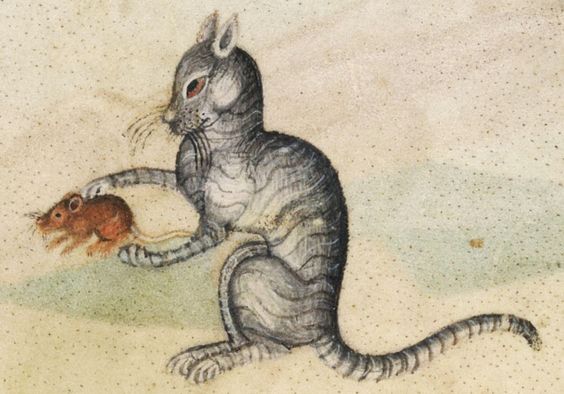
The people of the Middle Ages saw cats in both a positive and negative light. Their biggest “plus” was that cats caught mice, no small mercy in an age that was ridden with rodents. Some medieval commentators, however, compared the way in which cats toyed with the rodents before killing them to the way that the devil played with people’s souls before possessing them completely. From this comparison it was not a large step to believing that the cat, like the devil, could alter its shape and appearance for fair means and foul.  And there was something about the cat’s independence – its disdain for the closely-held belief that God had made animals for the service of humans – that provoked suspicion. And, it’s true that this view resulted in medieval cats being often very cruelly treated.

Fortunately, not everyone shared the suspicion; there is quite a lot of evidence in the literature of the time that shows that many medieval people were very fond of cats.  The Ancrene Wisse, an early 13th century guide for enclosed anchorites, recommends the keeping of a cat, and no other animal. In 14th century Exeter Cathedral had a cat on its payroll at 13 pence per quarter; and in the 1360s that amount was raised to 26 pence per quarter (though, perhaps, indicating an increasing rat problem that called for the employment of a second cat rather than representing a pay rise for the first cat).

A ninth-century monk inserted this poem to his cat in the margin of the manuscript he was working on:

So in peace our tasks we ply,
Pangur Bán, my cat, and I;
In our arts we find our bliss,
I have mine and he has his.

In fact, cats and manuscripts seemed to have gone together in the Middle Ages as can be seen by the paw prints left on a 15th century manuscript from Dubrovnik:

And such neat and strong paw prints they are, recorded for posterity. Now, a dog would never have been able to manage that!

Heaven S(c)ent

Fine perfume is, and always has been, a luxury item, its high price putting it out of reach of many people in poorer social circumstances. But, in the Middle Ages, perfume was not only an indicator of high social status but a necessity for anyone who could afford it. 

The streets and winding laneways of medieval towns were awash with dirt and foul-smelling waste products (of the animal, vegetable, and human kind), the limited lighting in most houses was by means of tallow candles which smoked and gave off a rancid odour, and the tightly-packed and poorly ventilated houses were musty. Scented oils in the dwellings and/or on the person provided a welcome relief from the daily assault on the olfactory senses of all. And it was believed that sweet fragrances warded off malodorous evil spirits. The pomander ball – a sort of spherical vase or container, or sometimes a bag filled with fragrant herbs – enabled individuals to carry a pleasant smell around with them, dispelling bad smells and (it was thought) evil infections in their wake.

At that time, perfumes were prepared by infusing oils (usually almond or olive) with flowers such as rose, lavender and violet, or with other readily available plants like lemon, and herbs such as thyme and sage. Resins helped fix the scent and, later, when the process of distillation was perfected, the production of perfume became more widespread and of a more commercial concern, expanding access to this important item.  

Patrick Suskind’s novel Perfume: The Story of a Murderer (1985) gives some wonderful details of the processes involved in creating special perfumes while, at the same time, offering a disturbing story about the evocative and provocative powers of scents and the sense of smell. Not a read for the faint-hearted (you might need your pomander ball close-by!).    

Lions and Dragons and Bears, Oh My!

In the Middle Ages, the understanding of the natural world was not based on scientific observation but on utility and moral applicability. This was particularly so for plants and animals: if they could be eaten (or could produce eggs, milk etc for human consumption) then they fitted into the scheme of things and were farmed or domesticated accordingly. However, many plants and animals defied ready explanation and represented, instead, a source of such wonder and (often) fear that their very existence could only be accommodated if they were regarded as serving a moral purpose. Enter the bestiary, a book that was a sort of compendium of beasts and animals, real and mythical, accompanied by a symbolic interpretation and a moral lesson, particular to each beast.

Although the bestiary had originated in the ancient world (with the volume known as Physiologus bringing together insights about animals from such authors as Aristotle and Herodotus), it was later Christian writers like Isidore of Seville and St Ambrose who gave the stories a moral and religious focus. Because the majority of the medieval populace was illiterate, the imparting of the Christian message in stories and allegories was an essential part of the Church’s teaching method. Nevertheless, the creatures presented in the medieval bestiaries were usually so exotic that their descriptions were often considered to be factual in many respects. Griffins, dragons, and unicorns featured along with lions and elephants.

Even in early times, the lion was considered to be the king of the beasts, and as such, generally is the first beast described in the bestiaries. Two types of lions are described: a timid lion which has a short body and curly hair (think, the Cowardly Lion in L. Frank Baum’s The Wizard of Oz); and a fierce lion with a longer body and straight hair. Both types were understood to have three particular attributes: the practice of erasing their tracks with their tail; always sleeping with eyes open; and giving birth to dead cubs which the mother brings to life on the third day by breathing into them.

The Christian association of Jesus with the lion is relatively straightforward: the lion as King of the Beasts = Jesus Christ the King. (In this aspect, such writers as C.S. Lewis with his character Aslan in The Lion, the Witch and the Wardrobe can be seen to be drawing directly on the medieval parallel). And the three attributes are similarly associated: the lion’s erasing of its tracks was representative of Jesus’s hidden divinity; its sleeping with eyes open represented Jesus’s (and all Christians) physical death to the world but spiritually alive and alert; and the lion cubs being brought to life after three days is, of course, allegorically standing for Jesus’s death and three days in his tomb before his resurrection.

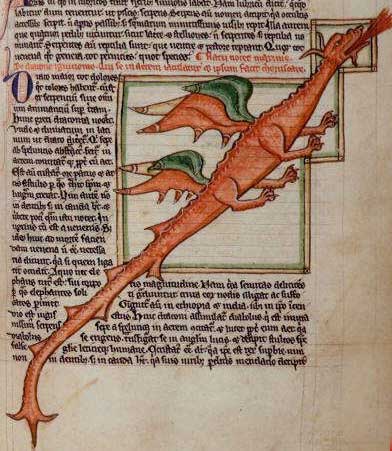
The bestiaries’ lion could be injured by a scorpion but it was only serpents that could kill it. And supreme among the serpents was the dragon, with its strength in its tail and not its teeth. Its thrashing, coiling tail enabled it to kill any animal – even one as large as the elephant – by suffocation. Thus, the dragon stood for the Devil, with his ability to squeeze the (holy) breath of life out of souls, suffocating them with sin. Further, with his fiery breath, the dragon could make the air shine and so he would sometimes appear to be an angel of light, tricking and luring the unsuspecting to their spiritual demise.

dragon

The dragons of today’s literature (for children in particular) are generally quite placid, with their mythic quality overtaking their earlier ‘evil’ connotations. 
I have a harmless dragon, myself, in my garden.

(Well, I hope he’s harmless!).

Thanks for the Memory

The 20th century philosopher, Gaston Bachelard, considered the house to be “one of the greatest powers of integration for thoughts, memories and dreams of mankind.”

Bachelard’s idea is really not a new one. In the Middle Ages, in that time prior to the invention of the printing press, and when access to books was very limited, the accurate recalling of huge chunks of information – even whole manuscripts – was not just an art but an essential skill for scholars who needed a reliable method of remembering information. And this method involved a house … of sorts.

Much earlier, Cicero, in his Rhetorica ad Herennium described a method of memory that was ‘locational’. That is, it involved the locating of specific things and ideas to be remembered within specifically-imagined rooms or architectural divisions in a ‘mind space’ (later known as the ‘memory palace’). Cicero’s method was revived in the monastic culture of the High Middle Ages with Hugh of St. Victor being a leading exponent in using architectural imagery to serve a mnemonic function. He, and others around the time, used as many of the senses as possible to support the mental impressions of objects, ideas, and entire texts that were to be placed in the memory palace for later retrieval. For example, different manuscripts might have had a different ‘feel’ or distinctive smell, and their contents may have reminded the scholar of an earlier experience, or even a friend. Inside the palace, different rooms served to house different categories of information and the scholar would ‘walk through the palace’ (of his mind), moving from the ‘general’ to the ‘specific’. With practice, no doubt, the ‘walk’ became quicker, more direct.

In addition to using such imagery for the purposes of remembering, it was in the medieval period, too, that the practice of finding associations between physical space and the spiritual space was distilled and enlarged. In part this was because the general populous was illiterate so that other things, besides words, needed to be able to be ‘read’ in order to convey information, specifically information of a religious nature. Thus, for example, the medieval cathedral was designed to be ‘read’ by the church goers with many things in the physical space being representational of something else in a ‘higher’ space. Every image in the stained glass windows, every carving on the great supporting columns, every leering gargoyle, told a story and taught a lesson. That is, sacred space, in the medieval period at least, was not just a space or place associated with divinity or religious worship but a vibrant representation of another even more vibrant spiritual reality.

This takes us back to our philosopher, Bachelard, who said that “Our soul is an abode. And by remembering ‘houses’ and ‘rooms’ we learn to abide within ourselves.” It’s an interesting idea but, as the average size of the Australian home has increased by around 50% in the last twenty years – from 169sq metres to 220 sq metres – I wonder if the physical edifice says more about our (external) desires and aspirations than about our souls.

Hildegard’s Marvellous Medicine

Hildegard’s Illumination:
Cycle of the Seasons

This is a reblog of my post of 17th January, 2017. Regular readers here will know that I often make reference to Hildegard of Bingen, and I’m reblogging this today because I’ll be doing a mini speaking ‘tour’ in Brisbane next week. The first of my talks is ‘Hildegard of Bingen’ for the Abbey Museum in Caboolture on 27th April. The second talk is an ‘author’s talk’ on my novel Grasping at Water at the Cedar & Pine Wine Bar in Wynnum on 29th April. If you’re in either neighbourhood, come along and say ‘Hello’.

Hildegard of Bingen, the 12th century Rhineland visionary, includes a remedy for jaundice in her extensive writings on medical topics. She advises the sufferer to wear a stunned bat (yes, of the mammalian kind) around his neck until the bat expires. To our modern sensibilities this recommendation seems useless at best but it was a treatment that was in keeping with the medieval understanding of human physiology and illness. That understanding had originated with Hippocrates (460-377BC) and Aristotle (384-324BC) and had been transmitted to the West via the writings of Galen (129-216AD) whose approach dominated the theory and practice of medicine throughout the Middle Ages.

                Following Galen, Hildegard regarded the human body as a microcosm of the vast macrocosm of the known universe which was believed to be made up of four elements: Earth, Fire, Water and Air.  All things – animate and inanimate – were composed of various combinations of these elements and of their contraries: cold, hot, moist, and dry. Particular combinations of any two of the contraries produced in each and every person one of four main Complexions or Temperaments and an accompanying predominant bodily fluid (humor).  Illness was understood as a disturbance in these humors and treatment sought to restore humeral balance. An overabundance of blood in the system, for example, was often treated by the application of leeches. Herbs, with their own particular humeral qualities, were a popular treatment as was careful attention to the patient’s diet.

Hildegard seems to have been an expert in the understanding and application of humeral theory. Among her many writings is a book of (medieval) “natural science”, Causae et Curae, in which she gives authoritative advice on treatment for all manner of ailments. For example, she recommends (a form of) the tansy herb to treat catarrh, and a brew of comfrey, marigold, wild sage and yarrow for easing pain associated with bruising following trauma.  Apples were a staple medicine.  When cooked  they were considered to be very beneficial for sick persons in general while a salve made from apple leaves was especially good for the eyes. No doubt this earlier medicinal use of apples is part of the basis for our present-day saying, “an apple a day keeps the doctor away.”  Mind you, apples are a lot easier to come by than bats. And I can’t help but wonder what I might have to do to “stun” a bat!

Eggs-actly: Medieval Easter Eggs

The season of Lent, which stretches over the forty days from Ash Wednesday to Easter Sunday, was a time of penance and fasting in the Christian medieval world. Fasting saw a prohibition on the eating of many foods, with meat, fat, milk and eggs being particularly forbidden. This may seem harsh to us now but, in fact, the Church had cleverly imposed the restrictions on a time of the year when the food reserves were most scarce anyway. That is, in Spring, the food stocks from the previous autumn’s harvests were at their lowest level after the long, cold winter. Thus, a social disadvantage was refashioned into a spiritual benefit.

The scarcity, however did not stop people from thinking about their favourite foods and, as the chickens did not stop laying completely, there sprang up the practice of preserving the eggs – by boiling – over the Lenten period, and often painting and decorating them in preparation for the celebration of Easter Sunday morning. Resourceful medieval folk also found ways to make mock, or substitute, eggs (at least as far as the outward appearance of the egg went) by blowing out egg shells and then filling them with an almond paste mixture, or even fish roe.

The prohibition on eggs also worked towards making them seem special, both as a food and a symbol and, unsurprisingly, various superstitions arose in relation to eggs at Easter. One such superstition was that an egg laid on Good Friday and kept for one hundred years, would turn into a diamond. Another was that eggs cooked on Good Friday and eaten on Easter Sunday would increase fertility (and the fertility belief also attached itself to the symbol of the rabbit/bunny – for obvious reasons!). And, if you were fortunate enough to bite into a double-yolked egg, future wealth was assured.

Of course, the religious significance of the egg at Easter was not overlooked, with adults hiding brightly coloured eggs for children to find in a symbolic reflection of the women finding Jesus’ tomb empty after his resurrection.

Happy Easter – eggs and all!

Kangaroo Court of Australia

Why rent a lawyer when you can buy a judge

Dally Messenger III

Social Integrity - Civil Celebrants - Politics and Current Affairs

Quodcumque - Serious Christianity

“Whatever you do, do it with your whole heart.” ( Colossians 3: 23 ) - The blog of Father Richard Peers SMMS, Director of Education for the Diocese of Liverpool

On Research

Age Concern New Zealand

Notes from the U.K.

Exploring the spidery corners of a culture and the weird stuff that tourist brochures ignore.

Zombie Salmon (the Horror Continues)

A blog about Horror fiction, Horror writing, and Horror criticism...a continuation of The Horror at Open Salon

Causeway Lit

An online literary journal

From my Mind

From My Mind: You can call this site as a personal blog or personal dairy: whatever it's I wanna call this site as my World. Because here, I post whatever it reaches my mind.

SHINE OF A LUCID BEING

Astral Lucid Music - Philosophy On Life, The Universe And Everything...

David Palethorpe

The thoughts, dreams and ideas of an insignificant speck of humanity in the Universe 😀

Ailish Sinclair

Stories and photos from Scotland

Unsophisticated Articles

A learning tool through experience

wake up and smell the humans

The website of Sean Crawley

The Reluctant Retiree

Stories from Garrulous Gwendoline - a baby boomer surviving retirement

The Immortal Jukebox

A Blog about Music and Popular Culture

KAGHAMAR

L'art de la Bible