

Mind Your Language

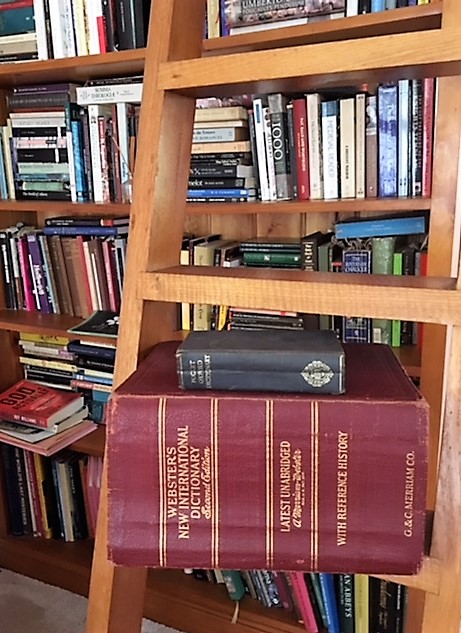
I love all the books (and there’s a lot of them) in my home library but the giant-sized Webster’s Dictionary (Unabridged) is one of my special favourites – all 3562 of its tiny-print pages. Each of its entries gives not only the current meaning of a word but also its origin and change/s in denotation and connotation over the centuries. Some words have flipped their meanings entirely. ‘Silly’, for example, now means ‘unwise, in want of understanding or common sense, foolish’; but the word originally came from the Old English (Anglo-Saxon) sælig meaning ‘happy, good, blessed’. We can easily imagine that part of the reason that ‘silly’ took a dive from the positive into the negative was the rise of rationalism and scientific dominance over religion.

On the other hand, ‘pretty’ has experienced a lift in meaning. In the original Anglo-Saxon prættig meant crafty, sly, deceptive. Well, maybe we can fill in the gaps as to how the more familiar meaning of ‘pleasingly attractive, good-looking’ evolved.

But, the big Webster’s is getting old now and, while its 1932 publication date has allowed me to dip into it for invaluable insights about the origins and evolution of much of our English language, the vernacular is a very fluid thing. This is why the modern dictionary compilers are always adding, and sometimes subtracting, and often re-defining, words and their meanings. Just this year (2023) Merriam Webster added 690 words and/or phrases, among them ‘cakeage’ which, following its earlier cousin, ‘corkage’, means a fee charged by a restaurant for a customer bringing in a cake to share with other guests at the table, rather than buying dessert from the restaurant; and ‘digital nomad’ which is used to describe a person working remotely whilst travelling. And then there’s the self-explanatory ‘nearlywed’ for those living together.

Similarly, the Oxford English Dictionary (OED) added around 700 words and phrases in the most recent quarter of 2023. There’s ‘side-hustle’, referring to a way of earning income on top of one’s main job; and ‘jabbed’ (and even ‘double-jabbed’ and ‘triple-jabbed’) in acknowledgment of life in a post-Covid world. And ‘gaslighting’, a word which had its origin in the 1930s play Gaslight by Patrick Hamilton (and more widely spread by the 1940 movie of the same name), has well and truly crossed into mainstream language with its recent inclusion in the OED. It’s defined as lying to someone for the purpose of mentally or emotionally manipulating them.

Now, that’s certainly not pretty, is it? (But it IS prættig!).
Mind Your Langauge

dictionary

I love all the books (and there’s a lot of them) in my home library but the giant-sized Webster’s Dictionary (Unabridged) is one of my special favourites – all 3562 of its tiny-print pages. Each of its entries gives not only the current meaning of a word but also its origin and change/s in denotation and connotation over the centuries. Some words have flipped their meanings entirely. ‘Silly’, for example, now means ‘unwise, in want of understanding or common sense, foolish’; but the word originally came from the Old English (Anglo-Saxon) sælig meaning ‘happy, good, blessed’. We can easily imagine that part of the reason that ‘silly’ took a dive from the positive into the negative was the rise of rationalism and scientific dominance over religion.

On the other hand, ‘pretty’ has experienced a lift in meaning. In the original Anglo-Saxon prættig meant crafty, sly, deceptive. Well, maybe we can fill in the gaps as to how the more familiar meaning of ‘pleasingly attractive, good-looking’ evolved.

But, the big Webster’s is getting old now and, while its 1932 publication date has allowed me to dip into it for invaluable insights about the origins and evolution of much of our English language, the vernacular is a very fluid thing. This is why the modern dictionary compilers are always adding, and sometimes subtracting, and often re-defining, words and their meanings. Just this year, Merriam Webster added such words as ‘truther’ – one who believes that the truth about something important is being hidden from the public and seeks to redress or expose the obstruction; and ‘photo bomb’ – someone moving deliberately into a photo shot as a joke or a prank.

The Concise Oxford English Dictionary (OED) added words like the double superlative ‘worstest’ to match its inclusion of ‘bestest’ in 2014. Other new entries in this year’s OED include ‘mankini’, ‘cyberbullying’, ‘sexting’ and ‘slow food’. There have also been changes and/or expansions in meaning for words like ‘friend’ which now takes in the Facebook variety of buddy. The word ‘follower’ has undergone a similar expansion – from old-style disciples to Twitter associations.

Now, is that pretty? Or is there something a little bit silly about that!

Kangaroo Court of Australia

Why rent a lawyer when you can buy a judge

Dally Messenger III

Social Integrity - Civil Celebrants - Politics and Current Affairs

Quodcumque - Serious Christianity

“Whatever you do, do it with your whole heart.” ( Colossians 3: 23 ) - The blog of Father Richard Peers SMMS, Director of Education for the Diocese of Liverpool

On Research

Age Concern New Zealand

Notes from the U.K.

Exploring the spidery corners of a culture and the weird stuff that tourist brochures ignore.

Zombie Salmon (the Horror Continues)

A blog about Horror fiction, Horror writing, and Horror criticism...a continuation of The Horror at Open Salon

Causeway Lit

An online literary journal

From my Mind

From My Mind: You can call this site as a personal blog or personal dairy: whatever it's I wanna call this site as my World. Because here, I post whatever it reaches my mind.

SHINE OF A LUCID BEING

Astral Lucid Music - Philosophy On Life, The Universe And Everything...

David Palethorpe

The thoughts, dreams and ideas of an insignificant speck of humanity in the Universe 😀

Ailish Sinclair

Stories and photos from Scotland

Unsophisticated Articles

A learning tool through experience

wake up and smell the humans

The website of Sean Crawley

The Reluctant Retiree

Stories from Garrulous Gwendoline - a baby boomer surviving retirement

The Immortal Jukebox

A Blog about Music and Popular Culture

KAGHAMAR

L'art de la Bible