
Sanitary Insanity

Every now and then I like to share an excerpt from my recent novel, Grasping at Water. The story is set in modern-day Sydney but there are medieval elements woven through it, usually in the form of a dream sequence or as ‘tales’ told by key characters. I’ve tried to make these medieval moments as authentic as possible, based on my many years of research, lecturing and writing on medieval topics. And, in line with that desire for authenticity, the following sample is about the [very] ‘basics’ of everyday life in the Middle Ages. There are two schools of thought on the question of how medieval townspeople disposed of the contents of their chamber pots each day. The first, and most widely held, is that the contents were thrown into the street (or river, if one was nearby) every morning; the second view is that, as some large towns such as London had statutes against such disposal, the towns were not as filthy as we might think. As you’ll see in the following excerpt, I subscribe to the former, majority opinion.

Excerpt from Grasping at Water (Odyssey Books) p.152-154

Kathryn is dreaming again. She knows she is dreaming and yet everything is so vivid that her sleeping self seems more real than her waking self. She is moving backwards down a dark tunnel. It is constraining, claustrophobically narrow. She wants to get out. Suddenly she is expelled from it but, immediately, she wishes to be back in the tunnel. In the world outside the tunnel she is surrounded by death. The stench is overwhelming. Cupping her hand over her mouth and nose she takes short, shallow breaths in an attempt to filter out the repugnant smell. Gagging, she raises her head from its downcast position and tries to make visual sense of the dreamscape in which she finds herself. She is leaning against a wall, a house wall. Her feet are standing on cobblestones. Everything around her is narrow. Across the narrow cobbled street she sees narrow, closely packed houses of uneven proportions, many with the upper storey protruding fifty centimetres or more over the lower storey, overhanging the street. The houses’ windows are narrow, mean, without glass and covered, instead, with what looks like oiled cloth. The doors are narrow and heavy. It looks like the medieval town that Sophia had described to her. From somewhere overhead, Kathryn hears a female voice shout out something in a strange accent. “Gardey loo; gardey loo,” calls the woman who Kathryn can now see is hanging out of the upper storey window of the house directly opposite where she is standing. She is holding some kind of a pot in her hands.

“What are you saying?” Kathryn calls back, stepping forward into the middle of the street. She is hit with a downpour of liquid and other matter; it drenches her head, sticks to her hair; and its overpowering odour tells her instantly that she is covered in urine and faeces.

“She was saying, gardez l’eau, and using the phrase to mean ‘watch out for the water’. But I see you got more than water,” laughs a well-dressed gentleman as he passes by. “These English have been bastardising the French language ever since the Norman Conquest.”

Kathryn wants to ask the gentleman more but he vanishes, clearly not belonging to this place and time. Kathryn wants to vanish from it too, but does not know how to do it. Instead, she takes a single, crumpled tissue from the inside of her sleeve and tries to wipe her face with it, tries desperately to remove the smell of the chamber pot’s contents from her nose.

Another woman at another second storey window a little further down the street, holds a chamber pot in her hands and cries, “Gardey loo,” and this time Kathryn does what she observes other pedestrians doing: scrambling for cover against the first storey walls of houses so that they are under cover of the overhanging second storeys. Up and down the street, the cry is repeated until the street is a shower of human waste products that splash into, and up from, the cobblestones, some of it clinging to the clothes and uncovered hands and faces of passersby, the majority of it pooling in the slightly concave centre of the street and mixing with other muck that coats the cobbles to form a lumpy, brown sludge that oozes and flows along the sloping thoroughfare and into the river at the end of the road. 

Kathryn hurries towards the river too, hoping that from its banks she will gain a perspective on where she is, and how she might escape. But on reaching the embankment, she is assailed by an even greater stench and it is not simply the result of the odious refuse and excrement that pours into the river from the streets that wind down to it. Kathryn sees that both banks are home to trades and industries that she takes some time to identify.

“Tanning and butchery,” says a scrawny woman crouched on the shore, and looking up at Kathryn as if she has read her dream-thoughts. “Stinks, doesn’t it? That’s because the butchers slaughter right here, on the river’s edge, and skin the animals as well. Then the skins are sold to the tanners next door and up along the river and they submerge the hides in a solution of lime and urine to dislodge the hair and fat. And then they rewash the hides by immersing them in either warm dogs’ dung or birds’ droppings. And then they drench in another solution of barley and urine or stale beer. They make beautiful leather here – oh, the shoes, belts, gloves, saddles and harnesses are something to behold. Still, the smell is so bad that even the rats keep away.”            

Kathryn does not dare to open her mouth to thank the strange woman for the information but, instead, looks down at her to acknowledge that she has heard what was said and is shocked to see that the woman is washing her clothes in the river, right next to the tannery’s outfall. And at various spots all along the river’s edge there are women washing clothes, immersing heavy fabrics in the water, then wringing them by hand and rubbing and scrubbing them on washboards, and spreading them out on the ground to dry. She feels herself retching. ______________


Being Green

A post inspired by ‘Seeing Green: A Philadelphia Story‘ by Yeah, Another Blogger

Medieval Green Man

Our English word for the colour ‘green’ comes from the Old English word grene which has the same word root as that of the words grass and grow. It’s no surprise, then, that we associate green with nature and new life. Similarly, in the Middle Ages, the colour green – with its profuse representation in the natural world – was a potent symbol of the beauty of God’s creation. God’s promise of hope, fertility, and abundance was renewed each year as people witnessed the green shoots of Spring pushing through the cold, hard earth of Winter.

The great 12th century abbess and visionary, Hildegard of Bingen, seems to have had quite a fondness for the colour green. Firstly, there is her detailed knowledge of, and admiration for, the plants and herbs of her locality which she used in healing medicines and ointments for her nuns and others needing treatment. Then, there are the green-themed ‘upmarket’ remedies that Hildegard recommended: She regarded the emerald as the “jewel of jewels” for treating many ailments – heart and stomach problems, headaches, even epilepsy. The emerald’s efficacy was due to its excessive greenness which, for her and others of the time, signified that it had absorbed all the green goodness of the natural world as it sprang back to new life each Spring. The emerald was not necessarily ingested, however; just wearing it as a charm or drinking some wine in which it had been placed was considered effective. (No doubt many of us would agree that wearing an emerald might make us feel better!). Hildegard also evoked greenness in relation to spirituality. She used the word viriditas (from the Latin meaning ‘greeness’) to describe the vitality, verdant beauty, and potential for growth of the human soul.

Not everyone saw green as a positive force, however. Some medieval churchmen were wary of the colour precisely because of its association with the natural world. That is, some saw green as representative of the pre-Christian religions that worshipped nature, and found their meaning in the renewal and abundance that the seasons brought. The medieval ‘Green Man’, depicted with his face and head surrounded by foliage, is a motif often found carved into medieval (English) churches. His incorporation into Christianity points to the way that the Church often managed to ‘neutralise’ the power of the Old Religions by appropriating their symbols. Some scholars think that the rise – in literature if not in fact – of the legendary outlaw, Robin Hood (topic for a later post), and his distinctive green clothing, was associated with some people’s yearning for a return to the old forms of worship.

The beauty of the colour green, however, overshadowed the negative associations and it was a popular choice in the illuminated manuscripts of the time. But it was tricky to make. The naturally occurring earth and plant greens were not lightfast and so a mix of the more sturdy primary colours – yellow and blue – gave the best effect. Or, sometimes, verdigris – made from the blue-green rust of copper – was a good alternative but, again, the green colour thus-produced tended to darken over time.

Actually, it was not until the 18th century that a vivid green was produced; and, unfortunately, as it was made by mixing copper with arsenic, it was a dangerous hue, considered responsible for the deaths of many, possibly even Napoleon Bonaparte who had a penchant for green (arsenic-based) wallpaper in his palaces. It was not until the early 20th century that a vivid and safe green was produced. As that great philosopher Kermit the Frog so often said: “It’s not easy being green”.

Seeing Green: A Philadelphia Story

In addition to being a good read, this post represents a practical exercise in mindfulness and observation, I think. It’s inspired me to think about the many meanings of the colour Green in medieval times – the topic for my next post. Thanks Neil.

Yeah, Another Blogger's avatarYeah, Another Blogger

Last Saturday, one day prior to St. Patrick’s Day, I was itching to stretch my legs. The skies were clear, the temperature tolerable, and my schedule was open. A walk was in order. Where, though? My ultra-hilly suburban neighborhood? Nah. I’d made the rounds there on foot a few days earlier, huffing and puffing my ass off as I scaled the slopes. Yo, there’s a limit to the number of hills this old boy is going to attempt to conquer during any given week, you dig?

Anyway, I was in the mood for some liveliness. And because my area is not blessed with lively as its middle name, I decided to do what I’ve done a ton of times before: Board a train in my little town and allow it to transport me to the mostly flat City Of Brotherly Love. I stepped into the choo-choo at about 10:40 AM…

View original post 963 more words

Hard Labour

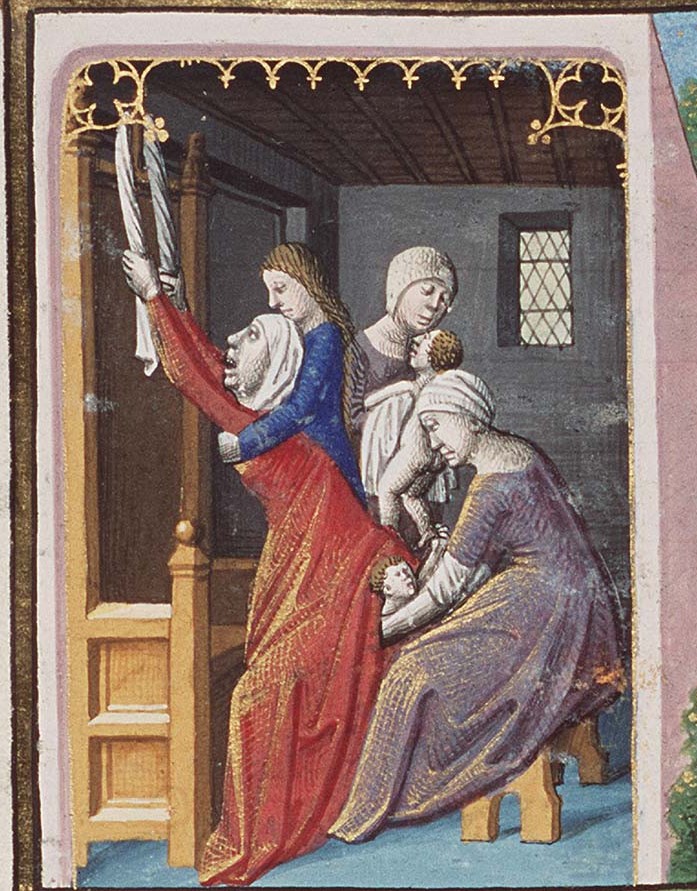
Giving birth in medieval times was a risky business – for mother as well as baby. While data from the era is scarce, a conservative estimate of maternal death (during the birth process or soon after, as a result of infection) was between 3% – 4% for each birth. And as women who survived the first birth would invariably go onto give birth again, and again, and again, the risk of death for any one woman was as high as 10%. Figures on infant mortality are even more scarce but estimates are put at between 30 – 50 %. (Such a figure may well include the death of infants due to infection in the first few weeks of life). It’s a grim picture and one that I had clearly in mind when I wrote about the birthing experience of one of the characters in my recent novel Grasping at Water (Odyssey Books, 2018). As some of you might know, the novel is set in modern-day Sydney and tells of the life-changing impact a mysterious young woman has on those with whom she comes in contact. The woman only reveals herself to others in medieval tales and the following is one such tale, an extract from the novel that I thought some of you might find interesting.

And then it is winter in the great town of Norwich in East Anglia. A bleak wind is blowing from the sea across the flat fenland, picking up cold moisture as it roars in, and dropping it as icy rain onto the town. In the town, the street that I see is not cobbled but is of packed-dirt and the freezing torrent has turned it to sticking mud. The surface gutters are clogged with putrefying waste, causing animal and human excrement to overflow and mix with the mud, all congealing into a sickly stew that coats traversers’ legs up to their knees in solid filth and fills their noses with a stench so vile that it liquefies in their lungs. Inside my house, a peat fire burns in the open hearth and warms the inhabitants but its smoke is thick, odorous and irritating. I am lying on a low settle bed in the corner of the dim, low-ceilinged room and I am coughing, the choking spasms adding to the severity of the pains of my labour that is now in its second day.  The blinding rain that has beset the town for three days has prevented the gathering and strewing of fresh rushes and fragrant herbs on the dirt floor of the lying-in room. No men are permitted near a birth but, nevertheless, I think of Hugh and long to see his face and have him touch my hand and kiss my mouth once more. He cannot. He is gone. Matilda, the midwife, and my mother attend me, tiredly but lovingly rubbing my belly and flanks with rose oil, and giving me a mixture of vinegar and sugar to drink. I am shivering with cold, with fear, with effort. Matilda unpins and loosens my hair, my mother opens a cupboard door and unties the knots in her apron cord so that the room is animated with opening and loosening in the hope that my laboring body will similarly slacken and open. Saint Margaret, the patron saint of childbirth, is invoked in fervent prayers. My pain increases, more slow hours pass, and still I labour without reward. Matilda and my mother speak to each other earnestly in whispers. A decoction of flaxseed and chickpeas is prepared and Matilda rubs this on her hands and then pushes her hands into me to rotate the baby who cannot find its way into the world because it is trying to enter feet-first. I am helped to the birthing chair and Matilda crouches between my shaking legs, easing, encouraging. My mother stands behind the chair, supporting me under my arms. I can barely stay upright let alone push so Matilda must pull. Amid screams and wails, a tiny, whimpering but beautiful boy is born.  I am cleaned and assisted back to the bed. He is bathed, rubbed with salt, warmly swaddled and placed on my breast. At first, his tiny, mewing mouth seeks nourishment but, like me, he is weak. I stroke his head, willing him to suck, but he does not. Such has been the stress of his arrival that he dies, pale and cold before he has had the chance to be pink and warm in my arms.

P

The luckless church

I really enjoyed and appreciated the (historical) details of the church in Elton, and I thought that some of my followers might enjoy it too.

Sue Vincent's avatarSue Vincent's Daily Echo

There is never enough time to explore everything on our travels. There are always intriguing buildings, signs and churches that we say we really must explore at some point… and never get the chance to see. So, if I get the chance at any point, I will try to rectify that. One grey day between Christmas and New Year, when I had a little time to spare, I took the car out to explore some of the lanes and villages that criss-cross ‘our’ patch in Derbyshire.

The village of Elton is one we have driven through on more occasions than we could count. We have passed through there every time we have visited the prehistoric landscape around Robin Hood’s Stride, Cratcliffe Tor and the Nine Stones Close stone circle…and we had never stopped to explore. Yet, Elton is an old village, mentioned in the Domesday Book of 1086…

View original post 877 more words

Song for summer

Summer in Sydney is at its height in January. The skies are clear and scorching heat sends us in search of the nearest beach or air-conditioner. With February just a few days away, we can look forward to some serious humidity coming our way, too, just as we all head back to work. Still, we can’t complain: the long, hot days and balmy evenings have been filled with Christmas and family, giant New Year celebrations, cricket, the Australian Open tennis; and, for many, some time away at the beach with family and friends. In our embracing of the (very) warm weather we’re no different from those who have gone before us.

In the Middle Ages, in Western Europe, the end of the long, hard winter was greeted with joy and celebration. In fact, one of the earliest surviving English songs is in praise of the arrival of summer. “Sumer is icumen in” was composed by an unknown composer in about 1260 in the Wessex dialect. In form the song is a “rota” which means that it is designed to be sung by two or more singers in a “round”, the first singer performing the first part just ahead of the second who, in turn, is just ahead of the next singer, and so on. You can hear a very merry version of it by the Lumina Vocal Ensemble at http://youtu.be/ZWWEHAswpFI or you might like the slower version with its clear Middle English pronunciation at   https://www.youtube.com/watch?v=sMCA9nYnLWo

And, in case you want to sing along, here are the words in both Middle and Modern English.

Middle English 
Sumer is icumen in,
Lhude sing cuccu!
Groweþ sed and bloweþ med

And springþ þe wode nu,
Sing cuccu!
Awe bleteþ after lomb,
Lhouþ after calue cu.
Bulluc sterteþ, bucke uerteþ,
Murie sing cuccu!
Cuccu, cuccu, wel þu singes cuccu;

Ne swik þu nauer nu.Sing cuccu nu. Sing cuccu.
Sing cuccu. Sing cuccu nu!
Modern English 
Summer has come in,
Loudly sing, Cuckoo!
The seed grows and the meadow
blooms
And the wood springs anew,
Sing, Cuckoo!
The ewe bleats after the lamb
The cow lows after the calf.
The bullock stirs, the stag farts,
Merrily sing, Cuckoo!
Cuckoo, cuckoo, well you sing,
cuckoo;
Don’t ever you stop now,Sing cuckoo now. Sing, Cuckoo.
Sing Cuckoo. Sing cuckoo now!

New Year, New Plans

Do you make New Year resolutions? As a (much) younger person I was a fan of the idea of resolving to do better in some specific way in all the months that stretched ahead of me in the coming year. Now I realise that those months contract more than stretch, and I’m inclined to count the positives each day brings rather than aim for more ambitious long-term goals.

A Christmas-New Year tale from the Middle Ages that puts the short-term positives vs the long-term ambition in interesting juxtaposition is an Arthurian story, Sir Gawain and the Green Knight. 

The story begins in Arthur’s court of Camelot where he and his knights are enjoying frivolous New Year games and gift-giving. The carefree atmosphere is shattered by the arrival of an unknown giant of a knight who is not only dressed all in green but also has skin of a green hue. Even his horse is green. Now, of course, in the broadest interpretation of this story opening, the ‘green knight’ represents the intrusion of the natural world (and the ‘old religions’) into a Christian setting but there are more important lessons in this story.

Once the shock of his entrance into the King’s court has subsided, the Green Knight proffers an axe and asks for a volunteer to cut off his head. The great King Arthur is shown to be a bit of a coward, as are many of his other knights as it is only young Sir Gawain who steps up to the challenge and removes the Green Knight’s head cleanly in one blow. To everyone’s surprise, however, the Green Knight bends down to pick up his own severed head and, propping it under his arm, continues to speak to the assembly. He reminds them that since “one good turn deserves another”, Sir Gawain is expected to seek him out at the same time next year so that he may remove Sir Gawain’s head.

The laws of chivalry required Sir Gawain to honour the request and so, in the biting winter of the following Christmas-New Year period, Gawain sets off on his quest.  His adventures en route to his destiny are too lengthy to describe here but what is really interesting about the fabulous Gawain is that, despite his honour and fortitude, he does eventually accept a talisman – a waist cord of green silk – that, while not allowing him to avoid his fate, will protect him from death. With such help, he still faces the Green Knight, still endures the strike of the axe, but his life is spared. Nevertheless, he must return (alive) to Arthur’s court with an obvious and an indelible scar on his neck. It is a bodily reminder of his human frailty. In addition, he decides to emphasise his lack of total courage by wearing the green cord as another sign of his imperfection. In support of his honesty, all the other Arthurian knights take to wearing green silk belts too.

In this New Year as we make all kinds of resolutions to be better than last year, I think that Gawain and the knights can teach us a valuable lesson about doing our best, honouring our commitments, acting with courage and behaving with dignity. But they can also remind us to accept that, despite our best intentions, we are only human; and our friends and family will love us, scars and all.

Less Holy Than Thou

Vincent at rochereau.wordpress.com has written this wonderful post on Margery Kempe, a fascinating women who has featured in a couple of my posts over the years.

Vincent's avatara wayfarer’s notes

Margery Kempe was a bloody-minded woman, living in a time when England was still Catholic. Bishops, priests and friars held worldly and spiritual power.
bloody-minded: Chiefly Brit. Perverse, contrary; cantankerous; stubbornly intransigent or obstructive. Cf. bloody adj. OED

She came from the provinces, had no education and bore 14 children to a husband socially beneath her. I feel for the poor man—read on and see.

View original post 1,637 more words

“This Creature”: 40 Years of Margery Kempe

I’ve written about Margery Kempe before in this blog (https://carmelbendon.com/2018/09/04/yes-power-2/ ) and I’m really pleased to be able to reblog this post on Margery from one of the world’s “Margery Kempe experts”, Clarissa Atkinson. Her book, “Mystic and Pilgrim: The Book and the World of Margery Kempe” was ground-breaking at its time of release, and remains essential reading for students of Margery. By the way, Margery Kempe was, in part, the inspiration for the modern-day character, Sister Margery Plimsoll, in my novel “Grasping at Water”.

Clarissa Atkinson's avatarThe Oldest Vocation

In the mid-1970s, casting about for a dissertation topic, I stumbled over Margery Kempe. In those days you had to stumble over her – she did not appear in the syllabus of any course in medieval studies, nor did she haunt the ether. (Not that we would have known if she had.) Students of medieval Christianity had probably heard of Margery, but very vaguely, with few specifics about her life or work. She was a mystic, sort of, but her book was not read along with Julian’s Revelations or The Cloud of Unknowing. It was not assigned.

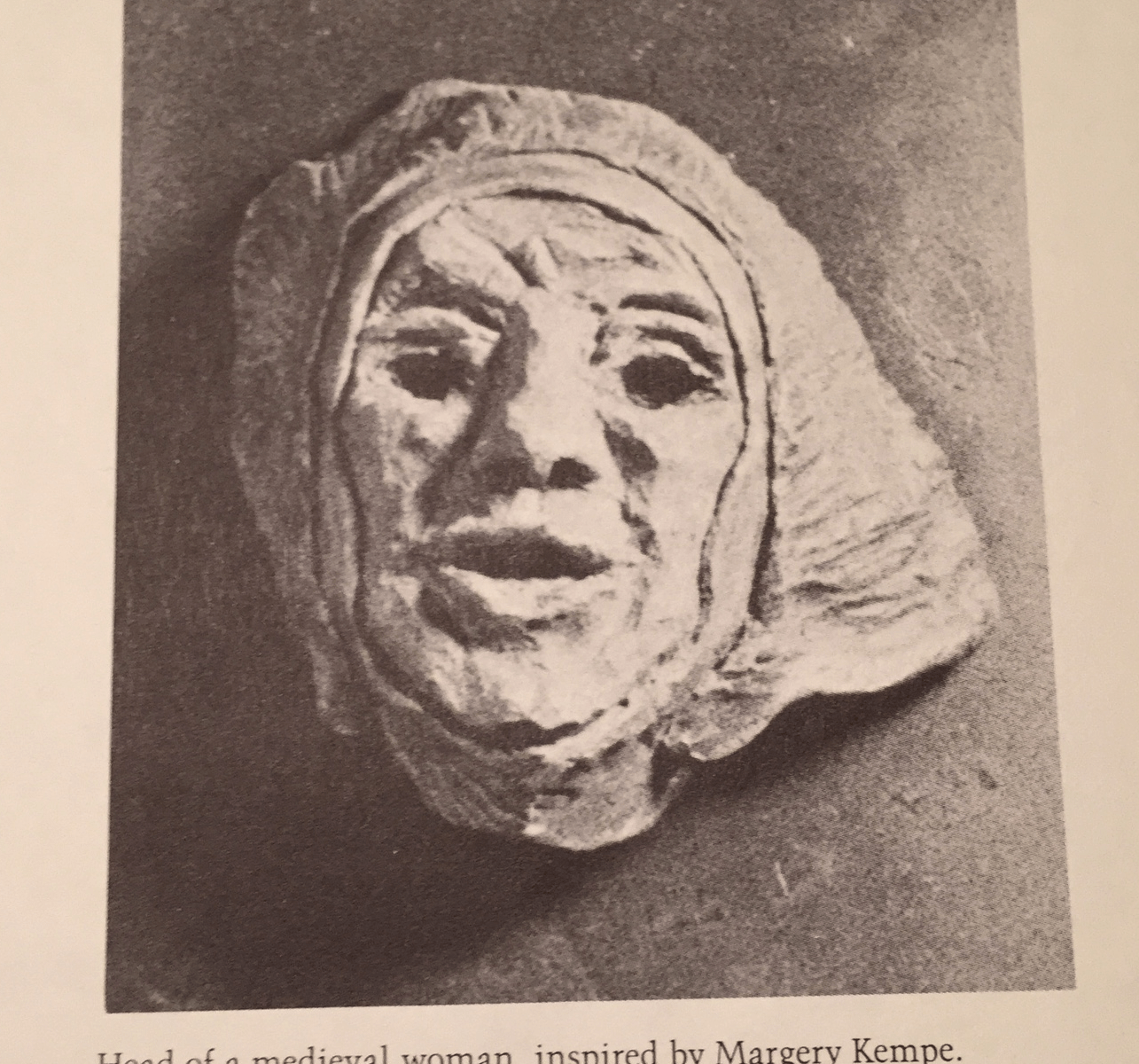
sculpture crop Frontispiece to my book: Mystic and Pilgrim: The Book and the World of Margery Kempe (Cornell University Press, 1983)

Margery Kempe was an English woman of the late 14th, early 15th centuries who “wrote” a kind of memoir – dictated it, really, as she couldn’t read or write. It was…

View original post 1,612 more words

Hey, hey, windy day

Windy_weather

Today in Sydney there is a wild wind blowing. Trees are down and flights have been cancelled. We only have to look (or venture) outside to see (and feel) the effects of the strong wind but exact measurement of weather components is a sophisticated process in our modern world. Of course, now, accessing those components and getting the latest weather updates and warnings is as simple as a few clicks through to the Bureau of Meteorology but the understanding and interpretation of weather in the Middle Ages was a very different thing. And instruments were limited. It wasn’t until after the Middle Ages – in the late 1500s – that Galileo invented a basic thermometer; and it was 1644 when Galileo’s colleague, the physicist and mathematician, Evangelista Torricelli, invented the barometer for measuring atmospheric pressure. Before that, the medieval people used weather vanes – with the word vane deriving from the Old English word fana meaning flag – for the indication of wind direction, and relied mainly on their own subjective views and experience of what was happening around them for further weather information.

That is, sources for weather data for the medieval period are scarce and historians generally now turn to chronicles and narrative accounts for their insights into climate and its effects. In most instances, objective evidence is limited largely to the observation of physical changes to the local environment brought about by weather and climate events.  For example, the following vivid description of a thunderstorm which took place in northern England in July 1293 is given in Chronicle of Lanercost :

“Early in the morning…we beheld in the east a huge cloud blacker than coal, in the midst whereof we saw the lashes of an immense eye darting fierce lightning into the west; whence I understood that Satan’s darts would come from over the sea. … [and] there began and continued throughout the night over the whole of the west part of the diocese of York, thunder and lightning so prodigious that the dazzling flashes followed each other without intermission, making, as it were, one continuous sunlight. Not only men were terrified and cried aloud, but even some domestic animals – horses, for certain. In some places houses were burnt or thrown down, and demons were heard yelling in the air.”

And, in my opinion, the best ‘potted’ description of the extremes of the seasons is given in the anonymously authored 14th century alliterative poem Sir Gawain and the Green Knight. Here’s an extract, first in the Middle English, and then in translation:

Bot þenne þe weder of þe worlde wyth wynter hit þrepez,
Colde clengez adoun, cloudez vplyften,
Schyre schedez þe rayn in schowrez ful warme,
Fallez vpon fayre flat, flowrez þere schewen,
Boþe groundez and þe greuez grene ar her wedez,
Bryddez busken to bylde, and bremlych syngen
For solace of þe softe somer þat sues þerafter
bi bonk;
And blossumez bolne to blowe
Bi rawez rych and ronk,
Þen notez noble innoȝe
[folio 98r]
Ar herde in wod so wlonk.
After þe sesoun of somer wyth þe soft wyndez
Quen Zeferus syflez hymself on sedez and erbez,
Wela wynne is þe wort þat waxes þeroute,
When þe donkande dewe dropez of þe leuez
To bide a blysful blusch of þe bryȝt sunne.
Bot þen hyȝes heruest, and hardenes hym sone,
Warnez hym for þe wynter to wax ful rype;
He dryues wyth droȝt þe dust for to ryse,
Fro þe face of þe folde to flyȝe ful hyȝe;
Wroþe wynde of þe welkyn wrastelez with þe sunne,
Þe leuez lancen fro þe lynde and lyȝten on þe grounde,
And al grayes þe gres þat grene watz ere;
Þenne al rypez and rotez þat ros vpon fyrst,
And þus ȝirnez þe ȝere in ȝisterdayez mony,
And wynter wyndez aȝayn, as þe worlde askez,
no fage,

But then the world’s weather wrestles with winter:
cold clings to the ground, but clouds rise,
releasing warm rain; rinsing showers
fall to the flat earth; flowers appear,
both field and forest are fringed with green.
Birds busy themselves building, and with brilliant song
celebrate summer, for soon each slope
will rush
                     to bloom with blossoms set
                     in lines luxuriant and lush,
                     while noble notes form nets
                     that fill the forest hush.

Then the summer season when the west breeze blows
and soft winds sigh on seed and stem.
How the green things glory in their urgent growth
when the dripping dew drops from the leaves,
waiting for the warm sun’s welcome glance.
But then Fall flies in, and fills their hearts,
Bidding them be rich, ripe, and ready for winter.
The autumn drought drives up dust
that billows in clouds above the broad earth.
Wild winds whistle, wrestling the sun;
Leaves launch from each limb and land on the soil,
while the green grass fades to grey.
What rose at the first now ripens and rots
till the year has gathered its full yield of yesterdays.
In the way of the world, winter winds

Much nicer description of the weather than we’ll hear on tonight’s TV weather, don’t you think?

Kangaroo Court of Australia

Why rent a lawyer when you can buy a judge

Dally Messenger III

Social Integrity - Civil Celebrants - Politics and Current Affairs

Quodcumque - Serious Christianity

“Whatever you do, do it with your whole heart.” ( Colossians 3: 23 ) - The blog of Father Richard Peers SMMS, Director of Education for the Diocese of Liverpool

On Research

Age Concern New Zealand

Notes from the U.K.

Exploring the spidery corners of a culture and the weird stuff that tourist brochures ignore.

Zombie Salmon (the Horror Continues)

A blog about Horror fiction, Horror writing, and Horror criticism...a continuation of The Horror at Open Salon

Causeway Lit

An online literary journal

From my Mind

From My Mind: You can call this site as a personal blog or personal dairy: whatever it's I wanna call this site as my World. Because here, I post whatever it reaches my mind.

SHINE OF A LUCID BEING

Astral Lucid Music - Philosophy On Life, The Universe And Everything...

David Palethorpe

The thoughts, dreams and ideas of an insignificant speck of humanity in the Universe 😀

Ailish Sinclair

Stories and photos from Scotland

Unsophisticated Articles

A learning tool through experience

wake up and smell the humans

The website of Sean Crawley

The Reluctant Retiree

Stories from Garrulous Gwendoline - a baby boomer surviving retirement

The Immortal Jukebox

A Blog about Music and Popular Culture

KAGHAMAR

L'art de la Bible