
To Bee or Not to Bee

beekeeping_2.jpg

The keeping of bees for their honey and other products such as pollen and beeswax is a practice that dates far back into human civilisation. Pottery beekeeping vessels of around 10,000 years of age have been found by archaeologists and the interest in the farming of bees has been continuous across the centuries and in most cultures.

In medieval Europe, beekeeping was well established. While we now think of the sweetness of the bees’ honey as the important product, in the Middle Ages the beeswax was equally prized and was used in the making of good quality candles and writing tablets.

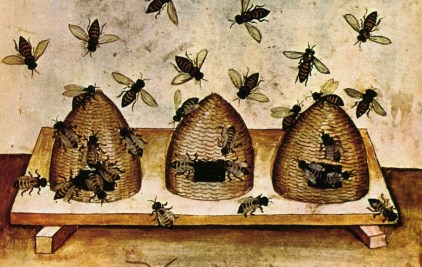
beekeepingBeehives were made of pottery or wood or wicker, and generally cone-shaped. In colder climates, and in the winter months of more temperate zones, the hives were layered with straw to keep the bees warm (and alive). Harvesting of the bees’ honey and other products was effected by fumigating the hives with thick smoke. This method saved the beekeeper from being stung but, unfortunately, killed the bees so that new swarms needed to be sourced regularly.

While the bees’ products were greatly admired and sought after, there were other “bee” qualities that had come to attention over the centuries. The great Greek philosopher Aristotle (384-322 BC) devoted a long (and keenly-observed) chapter (XL) of his ‘The History of Animals’ to the bee, describing its work and life habits and the society of the hive. Here’s a small selection:

 Bees scramble up the stalks of flowers and rapidly gather the bees-wax with their front legs; the front legs wipe it off on to the middle legs, and these pass it on to the hollow curves of the hind-legs; when thus laden, they fly away home, and one may see plainly that their load is a heavy one. On each expedition the bee does not fly from a flower of one kind to a flower of another, but flies from one violet, say, to another violet, and never meddles with another flower until it has got back to the hive; on reaching the hive they throw off their load, and each bee on his return is accompanied by three or four companions. …  Bees seem to take a pleasure in listening to a rattling noise; and consequently men say that they can muster them into a hive by rattling with crockery or stones; it is uncertain, however, whether or no they can hear the noise at all and also whether their procedure is due to pleasure or alarm. They expel from the hive all idlers and unthrifts. As has been said, they differentiate their work; some make wax, some make honey, some make bee-bread, some shape and mould combs, some bring water to the cells and mingle it with the honey, some engage in out-of-door work. At early dawn they make no noise, until some one particular bee makes a buzzing noise two or three times and thereby awakes the rest; hereupon they all fly in a body to work. By and by they return and at first are noisy; then the noise gradually decreases, until at last some one bee flies round about,making a buzzing noise, and apparently calling on the others to go to sleep; then all of a sudden there is a dead silence. … The hive is known to be in good condition if the noise heard within it is loud, and if the bees make a flutter as they go out and in; for at this time they are constructing brood-cells. They suffer most from hunger when they recommence work after winter.

Medieval authors also appreciated the importance of the general qualities of the bee and, in the medieval Christian literary milieu, the bee was often called into service as an analogy for hard work and persistence in the spiritual life. Richard Rolle, the Hermit of Hampole (c.1300-1349), demonstrates this approach in his “Allegory of the Bee [and the Stork]”. In part, he writes that

The bee has three qualities. The first is that she is never idle, and she never associates with those who refuse to work …. . A second is that when she flies she picks up earth in her feet so that she cannot easily be blown too high in the air by the wind. The third is that she keeps her wings clean and bright … .

The spiritual and moral lessons are quite obvious in Richard Rolle’s allegory: Work hard, stay grounded, keep clean in mind, body and spirit.

So …. Time to get back to work but, as you do so, remember:

The men of experiment are like the ant; they only collect and use. But the bee…gathers its materials from the flowers of the garden and of the field, but transforms and digests it by a power of its own. 
     Leonardo da Vinci

 Life is the flower for which love is the honey. 
     Victor Hugo

Tart words make no friends; a spoonful or honey will catch more flies than a gallon of vinegar.
      Benjamin Franklin


A Flight into the Dark Night

Night_darkness


Many of us have had the experience of preparing for an overseas holiday. As the time for departure grows closer, there’s often a feeling of anxiety mixed with the excitement of anticipation as we try to tidy the house and garden, make sure the newspaper and other deliveries are cancelled, organise accommodation for the pets, pay the bills, purchase travel insurance, renew the passport and so on. On the day of departure, just before we’re leaving for the airport, we run around checking that all the appliances are turned off, all the doors and windows are secured and the perishables are thrown out of the fridge and pantry. Even as we board our flight we may have a sudden thought that we’ve left the iron on; but once that plane accelerates down the runway and then lifts its nose skyward and we feel ourselves leave the ground, we know there’s nothing else we can do about any unfinished tasks at home. We’re lifted into a “between” state of being – not at home, yet not at our destination, detached from a clear sense of place, and completely “ungrounded”. Yet, there is an accompanying feeling of freedom, of leaving the mundane behind and of going towards the exciting unknown.

            In some ways, this physical experience of being “betwixt and between” is comparable to the psychological and spiritual idea of detachment. The great 16th century Spanish poet and mystic, St John of the Cross, opens his beautiful account of the soul’s journey towards union with God with the following lines:

On a dark night,

Kindled in love with yearnings

Oh happy chance!

I went forth without being observed,

My house being now at rest.

Here, the “house” is the body with all its senses that bristle and alert us and keep us connected to worldly concerns and emotions. In bringing the house to rest, in detaching from its concerns, John of the Cross regards the soul as liberated to soar into that dark night which he views as being an assent to live in total darkness with regard to all created things. Two centuries earlier, in the medieval period, the anonymous author of The Cloud of Unknowing described the detachment experienced during contemplation and meditation in a similar way: an intermediate state between two clouds – “a cloud of forgetting” below and “a cloud of unknowing” above, between the contemplative and God. The Cloud author further posed that darkness was not an absence of light but, rather, an absence of knowing [of God] and as, in his view, God cannot be known but only loved, darkness and detachment are desirable states in which to find oneself. More recently, and similarly, I have heard the Dalai Lama describe the concept of detachment very simply as being in a state of “nothingness: no-thing-ness”.

                        Some recent scholars, too, have described the “dark night” in psychological terms as the detachment of the ego, a letting go of the self and all its props. While letting go of illusions about ourselves can be confronting enough to plunge us into our own version of a “dark night”, perhaps we might usefully consider St John’s reference to the “happy chance”. That is, when those rare opportunities of bringing our “house to rest” present themselves, we should take them – for meditation or a walk in the garden, thus allowing ourselves to be more open to life’s possibilities, more open to an unplanned journey into a dark night.


Forks in the Road (and other cutlery)

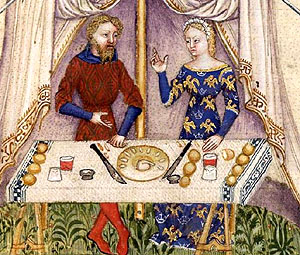
knives_eating

Western table cutlery settings today always feature a knife, fork and spoon, each one with its particular use. Spoons for the soups, sauces; knives for cutting food into manageable pieces; forks for moving the food from plate to mouth. But this organised (and well-mannered) approach is relatively new – at least in terms of human civilisation.

Knives were probably the first of the ‘cutlery set’ to appear. Evidence dates them right back to pre-historic times when sharpened flints, volcanic glass and bones were among the earliest cutting implements in use. With the advent of the Bronze and Iron Ages, knife blades became more sophisticated and, though still used primarily for hunting and as weapons, the knife’s utility was hard to ignore, and smaller versions of it became handy for assisting in eating and cutting in general.

Spoons have been around since the Stone Age too, with shaped stones, shells and hollowed-out animal horns being some of the discoveries that testify to their use.

Forks were known in Greek and Roman times but virtually disappeared from use during the Christian Middle Ages. Some historians have suggested that the fork’s shape was too reminiscent of the devil’s pitchfork but it is more likely that the knife’s versatility – it could be used for spearing food and bringing it to the mouth as well as cutting it – overrode the need to invest too much time and craftsmanship into the fork. And hands were, well, just as ‘handy’ for picking up food (and always ‘on hand’). It seems, however, that the fork did reappear in Western Europe in the 16th century when courtly society deemed that eating was more politely accomplished by digging forks rather than hands into food.

In the Middle Ages all travellers carried their own knife and spoon for eating when staying at an inn on the journey as the innkeeper did not provide guests with cutlery because such useful, well-crafted, and portable items were considered too ‘tempting’ and likely to be stolen by passing strangers: a different take on the “dish ran away with the spoon” in the Hey Diddle Diddle nursery rhyme (which, by the way, seems to date back in some form to medieval times).

One of my favourite ‘literary spoons’ is the runcible spoon in the final part of Edward Lear’s wonderful poem The Owl and the Pussycat:

They dined on mince and slices of quince

Which they ate with a runcible spoon

And hand in hand by the edge of the sand

They danced by the light of the moon, the moon

They danced by the light of the moon.

‘Runcible’ is today said to describe a sort of combination fork, spoon and knife; a fork with a curved section like a spoon, and with three broad prongs, one of which has a sharpened outer edge for cutting. In Australia we might call such an implement a ‘splayd’ or a ‘spork’. Actually, though, Edward Lear made up the word (along with others of his invention) as a whimsical addition to his poem. And cutlery to match the whimsy followed.

Enjoy your dinner!

Perchance to Dream

dreams

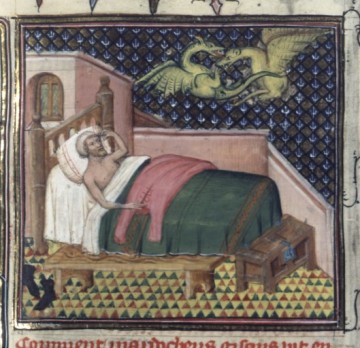
Dreams, as we all know, are complicated. Sometimes they are pleasant, sometimes terrifying, but always they leave us with fleeting and fractured impressions of our sleeping subconscious after we wake from them. Interest in dreams goes back a long way into our human history; and throughout the ages there has been no shortage of authors putting quill to parchment for the purpose of exploring the dream-state more deeply.

Cicero, the great Roman orator and statesman, and consul of Rome in 63BC, is among the many who wrote about dreams. In fact, his Somnium Scipionis (The Dream of Scipio) became one of the most influential works on dreams for later medieval writers. Cicero’s story of the dream of Scipio Africanus – in which the subject’s grandfather appears to him and gives him insights into such heady topics as cosmology and the immortality of the soul – made such an impression on the early medieval writer, Macrobius, that he wrote a detailed commentary on Scipio’s dream, developing the elaboration into a classification method for dreams in general.

Macrobius’s method distinguished 5 types of dream. The first two types (nightmare and apparition) he declared as ‘insignificant’ because he believed them to be non-predictive/non-prophetic (and, therefore, of no practical use to one’s present or future life). Such dreams, he said, were brought about by day-time anxiety or stress or, in particular, over-indulgence in the wrong kind of food and drink.

The next three types in the classification, however, were of great significance:

  • The somnium or enigmatic dream in which strange shapes and symbols represent important meanings that must never be ignored but always carefully interpreted.
  • The visio or prophetic visionary dream which is a clear glimpse or insight into what is to come.
  • The oraculum in which someone of importance and/or great wisdom (from the past or present, dead or living) appears to the dreamer to impart information or advice.

Such credence was given to Macrobius that, in the later Middle Ages, a whole genre of dream-vision poetry developed with his classifications as the base and inspiration. Great medieval authors such as Chaucer (who not only wrote many dream-vision poems but actually mentions Macrobius’s Scipio in at least three of them) and Guillaume de Lorris (Romance of the Rose) were masters of the genre. Even Dante’s epic The Divine Comedy is a vision of the world beyond death.

Today, of course, most writers are cautious about employing the dream device but, for medieval authors, it was regarded as a skilful way of bringing together the worlds of reality and imagination. Then, too, the division between the material and the spiritual was much more fluid, less stringently applied than in our own matter-of-fact time. Now, the dream (and even sleep itself) has been down-graded to a distant second-place behind our ‘real lives of busyness’. There is little time to ponder our dreams when all waking moments are taken up by the bright screens of modern technology.

Something to think about as you fall asleep tonight … unless, of course, you’ve over-eaten beforehand!

Mind Your Langauge

dictionary

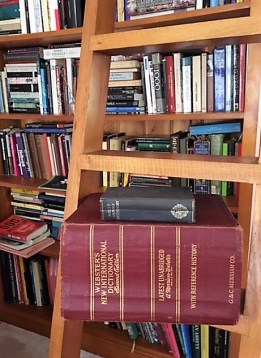
I love all the books (and there’s a lot of them) in my home library but the giant-sized Webster’s Dictionary (Unabridged) is one of my special favourites – all 3562 of its tiny-print pages. Each of its entries gives not only the current meaning of a word but also its origin and change/s in denotation and connotation over the centuries. Some words have flipped their meanings entirely. ‘Silly’, for example, now means ‘unwise, in want of understanding or common sense, foolish’; but the word originally came from the Old English (Anglo-Saxon) sælig meaning ‘happy, good, blessed’. We can easily imagine that part of the reason that ‘silly’ took a dive from the positive into the negative was the rise of rationalism and scientific dominance over religion.

On the other hand, ‘pretty’ has experienced a lift in meaning. In the original Anglo-Saxon prættig meant crafty, sly, deceptive. Well, maybe we can fill in the gaps as to how the more familiar meaning of ‘pleasingly attractive, good-looking’ evolved.

But, the big Webster’s is getting old now and, while its 1932 publication date has allowed me to dip into it for invaluable insights about the origins and evolution of much of our English language, the vernacular is a very fluid thing. This is why the modern dictionary compilers are always adding, and sometimes subtracting, and often re-defining, words and their meanings. Just this year, Merriam Webster added such words as ‘truther’ – one who believes that the truth about something important is being hidden from the public and seeks to redress or expose the obstruction; and ‘photo bomb’ – someone moving deliberately into a photo shot as a joke or a prank.

The Concise Oxford English Dictionary (OED) added words like the double superlative ‘worstest’ to match its inclusion of ‘bestest’ in 2014. Other new entries in this year’s OED include ‘mankini’, ‘cyberbullying’, ‘sexting’ and ‘slow food’. There have also been changes and/or expansions in meaning for words like ‘friend’ which now takes in the Facebook variety of buddy. The word ‘follower’ has undergone a similar expansion – from old-style disciples to Twitter associations.

Now, is that pretty? Or is there something a little bit silly about that!

Mirror, Mirror!

mirror

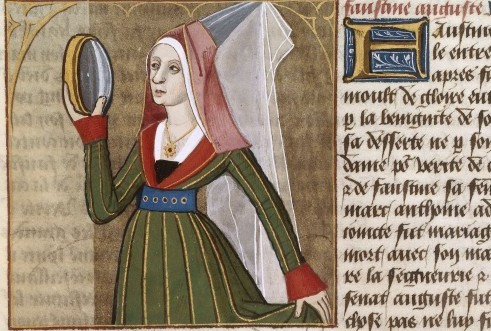
We all remember the magic mirror belonging to the evil queen in the fairytale, Snow White. Each day the queen would position herself in front of the mirror and ask, “Mirror, mirror, on the wall, who is the fairest of us all?” And the mirror would reply, “You are, O Queen.” The queen would be reassured for the moment, content in the mirror’s lie and its acquiescence to her vanity.

                Throughout history, the mirror has been one of the most prevalent and potent metaphors for the folly of human vanity. One of the foundational Western myths, for example, is the story of Narcissus who fell helplessly in love with himself when he discovered his reflection in a woodland pond. So taken was he with the beauty of his own image, he could not leave the pond and so died there.

Today we, too, seem to be obsessed with our own images. We wouldn’t think of leaving the house without first checking ourselves in the mirror. Lifts in buildings have mirrored walls so we can pass the time by looking at ourselves as we ascend or descend. There are mirror apps for our phones. And our mobile phones are the new mirrors, providing us with the instant ‘selfies’ that we can enhance (or delete) before sharing them with the world.  We spend countless billions on lotions and potions in attempts to beautify ourselves and to ward off the aging process. Beauty and youth are idealized and idolised in glossy magazines, on the big and small screen, and across social media. And the way to happiness is often touted as being as easy as a few deft swipes of the plastic surgeon’s knife. The idea is that we’re only as worthwhile as our outward appearance. If we don’t look good, we cannot be happy. In this way, the mirror is powerful because we allow it to have power.

And its power over humans started a long time ago. Archaeologists have found evidence of the earliest mirrors being simply polished surfaces of natural materials – rocks like obsidian, for example – which could reflect back an image, albeit a hazy one. With time, the crafting of metals – copper, silver, gold – gave the self-viewer a slightly clearer idea of him/herself but it was still a rudimentary reflection. The glass mirror – the closest ancestor of our contemporary mirrors – is recorded from Roman times but it was really during the Middle Ages that the quality of glass became good enough to return a clear reflection. Around that time, the manufacture of a much smoother glass enabled a relatively blur-free surface to be achieved and its reflective ability was increased by backing the glass with a metal such as gold leaf or a silver-mercury combination.

The medieval mirror par excellence was the work of Venetian glassmakers on the island of Murano. Their backing material of choice was kept secret for many decades but it was known to include mercury in the gilding process which, of course, made the final product ‘problematic’. Still, that didn’t dampen the general enthusiasm for mirrors (though, of course, their cost made them a luxury item for the wealthy only). After that, the reflective quality continued to improve over the centuries as production methods advanced the clarity of glass.

As far as the mirror was concerned, there was no looking back!

Author! Author!

venerableBede - Copy

I must confess that I’ve always had quite a bit of sympathy for the biblical ‘Doubting Thomas’.** It seems such a very human reaction to me to express incredulity at a man rising from the dead and to want to verify the event by reliance on one’s own senses. We doubt many things that we haven’t seen with our own eyes or perceived with our other senses. We are a society that demands proof as a matter of course. Business cannot function without written contracts; academic research builds on earlier (written) research results; the legal system insists on proof before a conviction can be recorded. We wouldn’t dream of taking a financial institution’s word as to our account balance – we must check the statement ourselves. MRIs and other technologically complex tests are necessary to probe and verify our illnesses. We cannot leave the country without a passport; nor can we be considered to even ‘exist’ without a birth certificate; and we’re only officially ‘dead’ when the Death Certificate is entered into the public record.

This wasn’t always the case. The Venerable Bede, for example, completed the writing of his Ecclesiastical History of the English People in 731. Bede was born in Northumbria in about 673 AD. At the age of seven he was given by his parents into the care of the Benedictines at the monastery of Saint Peter in Wearmouth in north-east England. In 682, Bede was transferred to a joint-foundation at Jarrow and there he remained as a monk until his death in 735. In the Preface to his history, Bede assures his readers that they can trust in all that he has written because, he states, “I am not dependent on any one person, but on countless faithful witnesses who either know or remember the facts”. That is, for Bede, the authenticity of his history comes not only from earlier written accounts but also from a variety of trusted oral and traditional sources. It is Bede’s words, and the words of those he trusted, that are presented as the impeccable credentials on which the veracity of his work rests.

In the High Middle Ages, too, the importance of trusting the words (written and spoken) of others found full realisation in the writing practice of NOT being seen to be original and creative but, rather, of being regarded as giving due acknowledgment to those who had gone before, of building on the firm foundations of the insights and achievements of previous generations. Bernard of Chartres’ saying (often incorrectly attributed as having its origin with Isaac Newton – though Mr Newton certainly said those words too), “We are as dwarves on giants’ shoulders …” is emblematic of the time which gave us the word ‘author’ from the Latin ‘auctoritas’ meaning ‘authority’. That is not to suggest, of course, that the great medieval writers were not creative; in fact, authors such as Geoffrey Chaucer and Marie de France (more of these in later posts) turned narrative conventions upside down to give us stories that are as fresh and relevant today as they were at their time of composition. And nor is it to suggest that the writings of the past centuries were all ‘true’ and utterly ‘honest’ representations of people’s lives and thoughts. The art of Rhetoric has been around since at least the days of the Ancient Greeks and part of the ‘authority’ that was passed on from them to the Western authors of the early and later Middle Ages was the insight that words are slippery, and can exert influence, menace, confusion as well as relay information and inspiration. 

The situation is no different today. So, what to do? The doubt of Thomas, the trust of Bede, the creative slipperiness of Chaucer? As a writer I’m opting for the third option; but in my everyday life I’m taking the middle ground: open mind and open heart with the occasional pinch of scepticism.


**Thomas, called the Twin, who was one of the Twelve, was not with them when Jesus came. When the disciples said, “we have seen the Lord”, he answered, “Unless I see the holes that the nails made in his hands and can put my finger into the holes they made, and unless I can put my hand into his side, I refuse to believe” (John 20: 24-29).

Raising Specks to the Spectacular

Meister_der_Manessischen_Liederhandschrift_001

O the dignity of that small speck of human dust
Taken by the jewel of heavenly excellence

To raise us from the clay of earth to heaven’s height
                                        (Gertrude the Great 1256-1302)

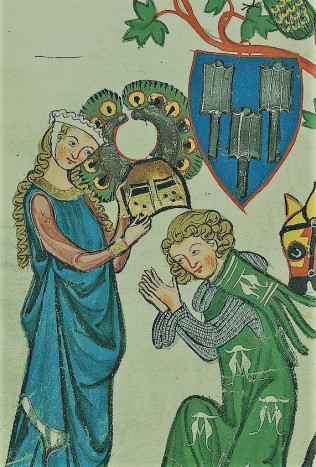
Gertrude the Great was a nun and mystic in the great Benedictine abbey of Helfta in Saxony. There she was one of a group of medieval women who later came to be known as “the scholars of Helfta” because of their extraordinary writings and mystical experiences. Gertrude’s prayer brings together two paradoxical aspects of our human existence – our insignificance in the grand scheme of things, and our dignity. Her lovely metaphor for each of us as “that small speck of human dust” is even more relevant today than it was when Gertrude composed her poem in the late 13th century.

Last time I checked, the world’s current population is around 7.5 billion people, and increasing at a rate of about 3 people per second. In the (population) scheme of things, a human individual is very insignificant indeed. And if that isn’t sobering enough, consider the fact that our Sun is only one of billions of stars in billions of galaxies in the universe. The total number of stars is calculated to be greater than all the grains of sand on Earth. Our Milky Way galaxy alone has about 400 billion stars. In effect, we’re a speck on a speck (Earth) in a spectacularly vast universe.

The 14th century English woman, Julian of Norwich (another great mystic), was also given a view of Earth’s smallness and insignificance in one of her (what she termed ) “Revelations of Divine Love”. In her writings on those profound revelations she explains that she was shown “a little thing, the size of a hazel nut, lying in the palm of my hand”. As she looked at it, she wondered what it could be and she was answered that “It is all that is made”. Julian admits that she was amazed that all of creation was so inconsequential and she was anxious about having the responsibility of holding it in her hand because she thought that “it might suddenly have fallen into nothingness because it was so little”. Julian’s anxiety was soothed when she was told that creation endures, and will continue to endure, because God loves it. It is a simple statement and yet it’s possibly the only answer that makes any sense to us: love endures.

We cannot hope to truly comprehend the vastness and complexity of our universe but we can understand, from our own everyday human experience, what it is to be loved and to love ourselves and others. Of course, to truly love others we must acknowledge their humanness – the positive and negative attributes of the personality, the annoying habits, the inconsistencies, the humour and kindness, the bad temper, the fears, the thoughtfulness, the failings as well as the successes. In our enduring love for others, we raise them up in our own estimation and, as a consequence, they are also raised in their own view  – from specks to spectacular. So, like Gertrude the Great, Joe Cocker was onto something in his song “Love Lifts us up Where We Belong”.


Heaven S(c)ent

distillingperfume

Fine perfume is, and always has been, a luxury item, its high price putting it out of reach of many people in poorer social circumstances. But, in the Middle Ages, perfume was not only an indicator of high social status but a necessity for anyone who could afford it.

The streets and winding laneways of medieval towns were awash with dirt and foul-smelling waste products (of the animal, vegetable, and human kind), the limited lighting in most houses was by means of tallow candles which smoked and gave off a rancid odour, and the tightly-packed and poorly ventilated houses were musty. Scented oils in the dwellings and/or on the person provided a welcome relief from the daily assault on the olfactory senses of all. And it was believed that sweet fragrances warded off malodorous evil spirits. The pomander ball – a sort of spherical vase or container, or sometimes a bag filled with fragrant herbs – enabled individuals to carry a pleasant smell around with them, dispelling bad smells and (it was thought) evil infections in their wake.

At that time, perfumes were prepared by infusing oils (usually almond or olive) with flowers such as rose, lavender and violet, or with other readily available plants like lemon, and herbs such as thyme and sage. Resins helped fix the scent and, later, when the process of distillation was perfected, the production of perfume became more widespread and of a more commercial concern, expanding access to this important item.

Patrick Suskind’s novel Perfume: The Story of a Murderer (1985) gives some wonderful details of the processes involved in creating special perfumes while, at the same time, offering a disturbing story about the evocative and provocative powers of scents and the sense of smell. Not a read for the faint-hearted (you might need your pomander ball close-by!).

Lions, and Dragons and Beasts, Oh My!

lion_bestiary

In the Middle Ages, the understanding of the natural world was not based on scientific observation but on utility and moral applicability. This was particularly so for plants and animals: if they could be eaten (or could produce eggs, milk etc for human consumption) then they fitted into the scheme of things and were farmed or domesticated accordingly. However, many plants and animals defied ready explanation and represented, instead, a source of such wonder and (often) fear that their very existence could only be accommodated if they were regarded as serving a moral purpose. Enter the bestiary, a book that was a sort of compendium of beasts and animals, real and mythical, accompanied by a symbolic interpretation and a moral lesson, particular to each beast.

Although the bestiary had originated in the ancient world (with the volume known as Physiologus bringing together insights about animals from such authors as Aristotle and Herodotus), it was later Christian writers like Isidore of Seville and St Ambrose who gave the stories a moral and religious focus. Because the majority of the medieval populace was illiterate, the imparting of the Christian message in stories and allegories was an essential part of the Church’s teaching method. Nevertheless, the creatures presented in the medieval bestiaries were usually so exotic that their descriptions were often considered to be factual in many respects. Griffins, dragons, and unicorns featured along with lions and elephants.

Even in early times, the lion was considered to be the king of the beasts, and as such, generally is the first beast described in the bestiaries. Two types of lions are described: a timid lion which has a short body and curly hair (think, the Cowardly Lion in L. Frank Baum’s The Wizard of Oz); and a fierce lion with a longer body and straight hair. Both types were understood to have three particular attributes: the practice of erasing their tracks with their tail; always sleeping with eyes open; and giving birth to dead cubs which the mother brings to life on the third day by breathing into them.

The Christian association of Jesus with the lion is relatively straightforward: the lion as King of the Beasts = Jesus Christ the King. (In this aspect, such writers as C.S. Lewis with his character Aslan in The Lion, the Witch and the Wardrobe can be seen to be drawing directly on the medieval parallel). And the three attributes are similarly associated: the lion’s erasing of its tracks was representative of Jesus’s hidden divinity; its sleeping with eyes open represented Jesus’s (and all Christians) physical death to the world but spiritually alive and alert; and the lion cubs being brought to life after three days is, of course, allegorically standing for Jesus’s death and three days in his tomb before his resurrection.

The bestiaries’ lion could be injured by a scorpion but it was only serpents that could kill it. And supreme among the serpents was the dragon, with its strength in its tail and not its teeth. Its thrashing, coiling tail enabled it to kill any animal – even one as large as the elephant – by suffocation. Thus, the dragon stood for the Devil, with his ability to squeeze the (holy) breath of life out of souls, suffocating them with sin. Further, with his fiery breath, the dragon could make the air shine and so he would sometimes appear to be an angel of light, tricking and luring the unsuspecting to their spiritual demise.

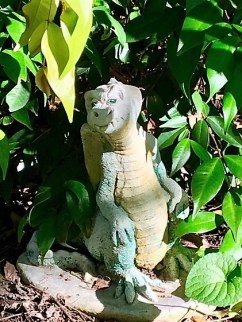
The dragons of today’s literature (for children in particular) are generally quite placid, with their mythic quality overtaking their earlier ‘evil’ connotations. dragon
I have a harmless dragon, myself, in my garden.


(Well, I hope he’s harmless!).


Kangaroo Court of Australia

Why rent a lawyer when you can buy a judge

Dally Messenger III

Social Integrity - Civil Celebrants - Politics and Current Affairs

Quodcumque - Serious Christianity

“Whatever you do, do it with your whole heart.” ( Colossians 3: 23 ) - The blog of Father Richard Peers SMMS, Director of Education for the Diocese of Liverpool

On Research

Age Concern New Zealand

Notes from the U.K.

Exploring the spidery corners of a culture and the weird stuff that tourist brochures ignore.

Zombie Salmon (the Horror Continues)

A blog about Horror fiction, Horror writing, and Horror criticism...a continuation of The Horror at Open Salon

Causeway Lit

An online literary journal

From my Mind

From My Mind: You can call this site as a personal blog or personal dairy: whatever it's I wanna call this site as my World. Because here, I post whatever it reaches my mind.

SHINE OF A LUCID BEING

Astral Lucid Music - Philosophy On Life, The Universe And Everything...

David Palethorpe

The thoughts, dreams and ideas of an insignificant speck of humanity in the Universe 😀

Ailish Sinclair

Stories and photos from Scotland

Unsophisticated Articles

A learning tool through experience

wake up and smell the humans

The website of Sean Crawley

The Reluctant Retiree

Stories from Garrulous Gwendoline - a baby boomer surviving retirement

The Immortal Jukebox

A Blog about Music and Popular Culture

KAGHAMAR

L'art de la Bible