
To Bee or Not to Bee

beekeeping_2.jpg

The keeping of bees for their honey and other products such as pollen and beeswax is a practice that dates far back into human civilisation. Pottery beekeeping vessels of around 10,000 years of age have been found by archaeologists and the interest in the farming of bees has been continuous across the centuries and in most cultures.

In medieval Europe, beekeeping was well established. While we now think of the sweetness of the bees’ honey as the important product, in the Middle Ages the beeswax was equally prized and was used in the making of good quality candles and writing tablets.

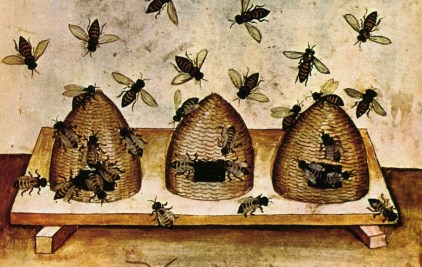
beekeepingBeehives were made of pottery or wood or wicker, and generally cone-shaped. In colder climates, and in the winter months of more temperate zones, the hives were layered with straw to keep the bees warm (and alive). Harvesting of the bees’ honey and other products was effected by fumigating the hives with thick smoke. This method saved the beekeeper from being stung but, unfortunately, killed the bees so that new swarms needed to be sourced regularly.

While the bees’ products were greatly admired and sought after, there were other “bee” qualities that had come to attention over the centuries. The great Greek philosopher Aristotle (384-322 BC) devoted a long (and keenly-observed) chapter (XL) of his ‘The History of Animals’ to the bee, describing its work and life habits and the society of the hive. Here’s a small selection:

 Bees scramble up the stalks of flowers and rapidly gather the bees-wax with their front legs; the front legs wipe it off on to the middle legs, and these pass it on to the hollow curves of the hind-legs; when thus laden, they fly away home, and one may see plainly that their load is a heavy one. On each expedition the bee does not fly from a flower of one kind to a flower of another, but flies from one violet, say, to another violet, and never meddles with another flower until it has got back to the hive; on reaching the hive they throw off their load, and each bee on his return is accompanied by three or four companions. …  Bees seem to take a pleasure in listening to a rattling noise; and consequently men say that they can muster them into a hive by rattling with crockery or stones; it is uncertain, however, whether or no they can hear the noise at all and also whether their procedure is due to pleasure or alarm. They expel from the hive all idlers and unthrifts. As has been said, they differentiate their work; some make wax, some make honey, some make bee-bread, some shape and mould combs, some bring water to the cells and mingle it with the honey, some engage in out-of-door work. At early dawn they make no noise, until some one particular bee makes a buzzing noise two or three times and thereby awakes the rest; hereupon they all fly in a body to work. By and by they return and at first are noisy; then the noise gradually decreases, until at last some one bee flies round about,making a buzzing noise, and apparently calling on the others to go to sleep; then all of a sudden there is a dead silence. … The hive is known to be in good condition if the noise heard within it is loud, and if the bees make a flutter as they go out and in; for at this time they are constructing brood-cells. They suffer most from hunger when they recommence work after winter.

Medieval authors also appreciated the importance of the general qualities of the bee and, in the medieval Christian literary milieu, the bee was often called into service as an analogy for hard work and persistence in the spiritual life. Richard Rolle, the Hermit of Hampole (c.1300-1349), demonstrates this approach in his “Allegory of the Bee [and the Stork]”. In part, he writes that

The bee has three qualities. The first is that she is never idle, and she never associates with those who refuse to work …. . A second is that when she flies she picks up earth in her feet so that she cannot easily be blown too high in the air by the wind. The third is that she keeps her wings clean and bright … .

The spiritual and moral lessons are quite obvious in Richard Rolle’s allegory: Work hard, stay grounded, keep clean in mind, body and spirit.

So …. Time to get back to work but, as you do so, remember:

The men of experiment are like the ant; they only collect and use. But the bee…gathers its materials from the flowers of the garden and of the field, but transforms and digests it by a power of its own. 
     Leonardo da Vinci

 Life is the flower for which love is the honey. 
     Victor Hugo

Tart words make no friends; a spoonful or honey will catch more flies than a gallon of vinegar.
      Benjamin Franklin


Cats to Conjure With

cat and mouse

I don’t have to think about it. I admit it: I am a dog person. There’s something about dogs’ joyful optimism and irrepressible enthusiasm for everything from food to a good stick that makes me happy; not to mention their devotion and companionship. And, in truth, I’ve never had a cat as a pet whereas I could not imagine home life without a dog. Nevertheless, I have friends who couldn’t live without their cats and so when I decided to write a blog or two on animals in the Middle Ages, I decided, in the interests of fairness and balance, to start with cats. (Dogs will follow at a later date).

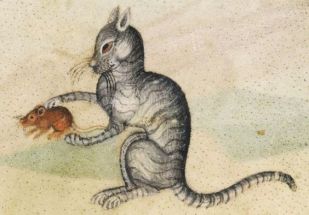
The people of the Middle Ages saw cats in both a positive and negative light. Their biggest “plus” was that cats caught mice, no small mercy in an age that was ridden with rodents. Some medieval commentators, however, compared the way in which cats toyed with the rodents before killing them to the way that the devil played with people’s souls before possessing them completely. From this comparison it was not a large step to believing that the cat, like the devil, could alter its shape and appearance for fair means and foul.  And there was something about the cat’s independence – its disdain for the closely-held belief that God had made animals for the service of humans – that provoked suspicion. And, it’s true that this view resulted in medieval cats being often very cruelly treated.

Fortunately, not everyone shared the suspicion; there is quite a lot of evidence in the literature of the time that shows that many medieval people were very fond of cats.  The Ancrene Wisse, an early 13th century guide for enclosed anchorites, recommends the keeping of a cat, and no other animal. In 14th century Exeter Cathedral had a cat on its payroll at 13 pence per quarter; and in the 1360s that amount was raised to 26 pence per quarter (though, perhaps, indicating an increasing rat problem that called for the employment of a second cat rather than representing a pay rise for the first cat).

A ninth-century monk inserted this poem to his cat in the margin of the manuscript he was working on:

So in peace our tasks we ply,
Pangur Bán, my cat, and I;
In our arts we find our bliss,
I have mine and he has his.

In fact, cats and manuscripts seemed to have gone together in the Middle Ages as can be seen by the paw prints left on a 15th century manuscript from Dubrovnik:

cat prints

And such neat and strong paw prints they are, recorded for posterity. Now, a dog would never have been able to manage that!

Let’s Dance

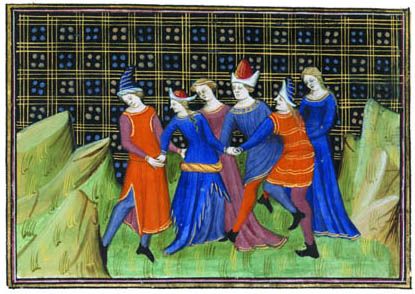
medieval dance


Some of you who have followed my blog for a while will know that the subject of my PhD thesis (over 18 years ago now) was, broadly, medieval mystics; and every now and then (well, quite often, actually) I am drawn back to their beautiful writings for inspiration. I am in one of those ‘phases’ currently so there might be a few ‘mystical’ posts making an appearance over the coming weeks. Today, I needed to reflect on one of my ‘favourites’ – the brilliant Mechtild of Magdeburg. Here she is:

Mechtild of Magdeburg was a medieval mystic whose visions and insights ranged, quite literally, from the depths of hell to the heights of heaven. She was born in Saxony in about 1210 and, from evidence within her own writings, seems to have experienced her first visions at the age of twelve. At about the age of twenty she left her home to become a Beguine[1] in the town of Magdeburg. There, under the spiritual guidance of the Dominicans, Mechtild’s visions continued and increased and she was encouraged to write them down. This she did in a text under the title of The Flowing Light of Godhead. However, Mechtild’s claim that God had directed her to record these insights and experiences attracted considerable suspicion and criticism, and this increased when, in turn, Mechtild voiced her own criticism of certain local and high-ranking clergy. As a result, for her own protection, in 1270, Mechtild was moved to the Cistercian convent of Helfta. There, in the company of other great mystics of the time, including Mechtilde of Hackeborn and St. Gertrude the Great, Mechtild passed the final years of her life, in writing and in prayer, until her death sometime between 1282 and 1290.

Mechtild’s writings are representative of the ‘affective’ or via affirmativa approach to mysticism in which the mystical experiences are recorded and conveyed in a language that is steeped in metaphor, analogy and sensual imagery. There is no doubt that Mechtild was a gifted poet and some scholars have, rightly, speculated on how much of her writing is attributable to actual mystical inspiration and how much to pure poetic expression. Her visions of hell and purgatory and heaven, in particular, are graphic enough to have prompted comparisons with Dante’s Divine Comedy, particularly as Mechtild’s version features descriptions of deeper and deeper levels of hell and purgatory where souls are tormented according to the severity of their sins. Some have even suggested that Mechtild’s descriptions were Dante’s inspiration and that Mechtild herself is represented in the poem as the character, Matelda. Such comparisons remind us that the ‘affective’ medieval mystics used not only beautiful imagery that elevates and delights the modern reader but also, sometimes, gritty and confronting imagery that challenges our modern sensibilities. Perhaps it is the ‘dance’ of these opposites that is one of the reasons that the mystics retain an appeal for us today. We, too, must live in a world that is often ugly and fraught with despair; but we also have the promise and knowledge of the great beauty of creation, and the undercurrent of something divine, mysterious and constant that somehow sustains and enlivens us. Perhaps ironically, then, the poem that is now most synonymous with Mechtild is about ‘the dance’ but, in this case, a very positive and beautiful dance with Divine Life.

I cannot dance, Lord, unless you lead me.
If you want me to leap with abandon,
You must intone the song.
Then I shall leap into love,
From love into knowledge,
From knowledge into enjoyment,
And from enjoyment beyond all human sensations.
There I want to remain, yet want also to circle higher still.        

(Mechtild of Magdeburg)

[1] A beguine was a woman who lived a life dedicated to God but who did not take the vows of religiously professed women. Instead, she lived with other similarly dedicated women who often worked in the community but returned to the “group house” (beguinage) to share in a community life of prayer. Topic for another blog.

Heaven S(c)ent

distillingperfume

Fine perfume is, and always has been, a luxury item, its high price putting it out of reach of many people in poorer social circumstances. But, in the Middle Ages, perfume was not only an indicator of high social status but a necessity for anyone who could afford it.

The streets and winding laneways of medieval towns were awash with dirt and foul-smelling waste products (of the animal, vegetable, and human kind), the limited lighting in most houses was by means of tallow candles which smoked and gave off a rancid odour, and the tightly-packed and poorly ventilated houses were musty. Scented oils in the dwellings and/or on the person provided a welcome relief from the daily assault on the olfactory senses of all. And it was believed that sweet fragrances warded off malodorous evil spirits. The pomander ball – a sort of spherical vase or container, or sometimes a bag filled with fragrant herbs – enabled individuals to carry a pleasant smell around with them, dispelling bad smells and (it was thought) evil infections in their wake.

At that time, perfumes were prepared by infusing oils (usually almond or olive) with flowers such as rose, lavender and violet, or with other readily available plants like lemon, and herbs such as thyme and sage. Resins helped fix the scent and, later, when the process of distillation was perfected, the production of perfume became more widespread and of a more commercial concern, expanding access to this important item.

Patrick Suskind’s novel Perfume: The Story of a Murderer (1985) gives some wonderful details of the processes involved in creating special perfumes while, at the same time, offering a disturbing story about the evocative and provocative powers of scents and the sense of smell. Not a read for the faint-hearted (you might need your pomander ball close-by!).

Lions, and Dragons and Beasts, Oh My!

lion_bestiary

In the Middle Ages, the understanding of the natural world was not based on scientific observation but on utility and moral applicability. This was particularly so for plants and animals: if they could be eaten (or could produce eggs, milk etc for human consumption) then they fitted into the scheme of things and were farmed or domesticated accordingly. However, many plants and animals defied ready explanation and represented, instead, a source of such wonder and (often) fear that their very existence could only be accommodated if they were regarded as serving a moral purpose. Enter the bestiary, a book that was a sort of compendium of beasts and animals, real and mythical, accompanied by a symbolic interpretation and a moral lesson, particular to each beast.

Although the bestiary had originated in the ancient world (with the volume known as Physiologus bringing together insights about animals from such authors as Aristotle and Herodotus), it was later Christian writers like Isidore of Seville and St Ambrose who gave the stories a moral and religious focus. Because the majority of the medieval populace was illiterate, the imparting of the Christian message in stories and allegories was an essential part of the Church’s teaching method. Nevertheless, the creatures presented in the medieval bestiaries were usually so exotic that their descriptions were often considered to be factual in many respects. Griffins, dragons, and unicorns featured along with lions and elephants.

Even in early times, the lion was considered to be the king of the beasts, and as such, generally is the first beast described in the bestiaries. Two types of lions are described: a timid lion which has a short body and curly hair (think, the Cowardly Lion in L. Frank Baum’s The Wizard of Oz); and a fierce lion with a longer body and straight hair. Both types were understood to have three particular attributes: the practice of erasing their tracks with their tail; always sleeping with eyes open; and giving birth to dead cubs which the mother brings to life on the third day by breathing into them.

The Christian association of Jesus with the lion is relatively straightforward: the lion as King of the Beasts = Jesus Christ the King. (In this aspect, such writers as C.S. Lewis with his character Aslan in The Lion, the Witch and the Wardrobe can be seen to be drawing directly on the medieval parallel). And the three attributes are similarly associated: the lion’s erasing of its tracks was representative of Jesus’s hidden divinity; its sleeping with eyes open represented Jesus’s (and all Christians) physical death to the world but spiritually alive and alert; and the lion cubs being brought to life after three days is, of course, allegorically standing for Jesus’s death and three days in his tomb before his resurrection.

The bestiaries’ lion could be injured by a scorpion but it was only serpents that could kill it. And supreme among the serpents was the dragon, with its strength in its tail and not its teeth. Its thrashing, coiling tail enabled it to kill any animal – even one as large as the elephant – by suffocation. Thus, the dragon stood for the Devil, with his ability to squeeze the (holy) breath of life out of souls, suffocating them with sin. Further, with his fiery breath, the dragon could make the air shine and so he would sometimes appear to be an angel of light, tricking and luring the unsuspecting to their spiritual demise.

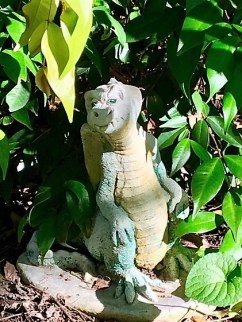
The dragons of today’s literature (for children in particular) are generally quite placid, with their mythic quality overtaking their earlier ‘evil’ connotations. dragon
I have a harmless dragon, myself, in my garden.


(Well, I hope he’s harmless!).


A Good Old-Fashioned Barber

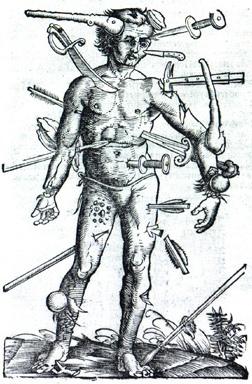
Wound_Man
A medieval Wound Man


In last week’s post I looked at the handy medieval medical guide for aligning bodily weaknesses with astrological influences as represented in “Zodiac Man”. The “Wound Man” served a similar purpose in that he was a visual compendium for the sorts of traumatic injuries that medieval surgeons might have to treat.

The medieval surgeon was not, of course, anything like the surgeon of our modern world. In fact, the medieval surgeon was often the local barber because one of the main criterion for “entry” to the profession was to be good with a knife or other blade. A barber had ready access, too, to these blades and plenty of practice and skill in using them on the human body.

The barbers’ poles of today, with their red and white intermingling spirals, are direct reminders of the dual skills of the barber of previous days. Originally the red represented the blood that the barber would draw from the patient either as a direct result of the surgery or as a deliberate outcome of bloodletting. This was a common medieval practice which involved the cutting open of a vein to allow the release of what was regarded as “excess blood” in the bodily humours. The pole’s white-coloured spirals, then, stood for the bandages that were applied to stem the wound at the conclusion of the “treatment”.

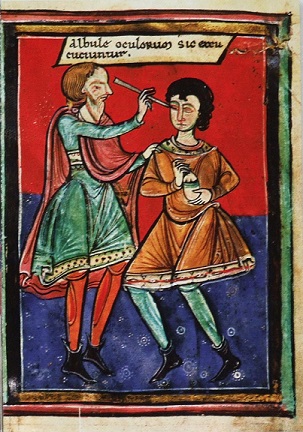
In the days before anaesthetic, surgery required a steady hand and it was not unusual that the surgeon was a woman. Her more delicate hands made the removal of anything from haemorrhoids to cataracts seem a little more bearable to the hapless patient.

cataract surgery
Medieval surgery for cataract removal

Something to think about next time you’re at the hairdresser.

Journey AND Destination – Pilgrimage

pilgrimage

Whan that April with his shoures soote
The droghte of March hath perced to the roote,
And bathed every veyne in swich licour
Of which engenred is the flour;
Whan Zephirus eek with his sweete breeth
Inspired in every holt and heeth
The tender croppes, and the Yonge sonne
Hath in the Ram his half cours yronne,
And smale foweles maken melodye,
That slepen al the nyght with open ye
(So priketh hem nature in hir corages),
Thanne longen folk to goon on pilgrimages.

(Geoffrey Chaucer, Prologue to The Canterbury Tales)

The medieval obsession with pilgrimage, immortalised and used as the basis of Chaucer’s great work, The Canterbury Tales, was a firm feature of medieval life. As Chaucer indicates, once Spring settled over the land, and the people were freed from the hardships of a rigorous Winter, folk of all types planned and set out on a pilgrimage. Pilgrimage, then as now, meant a journey with a spiritual objective to a religiously-significant destination.

In the Middle Ages, pilgrimages ranged from small journeys to the shrines of local saints, to more arduous and lengthy journeys to religious centres with soaring Gothic cathedrals, right up to the most demanding travel of all: the prized destinations of Rome, Compostela and the Holy City of Jerusalem.

Along the pilgrim routes which criss-crossed Europe, centres of economic prosperity arose in the service of catering to the pilgrims but, in reality, there was very little “vacation” to be found in these journeys. The pilgrim roads were fraught with dangers. It’s no coincidence that Chaucer’s Canterbury pilgrims met at an appointed time at the Tabard Inn so that they could make their pilgrimage in the company of others. A pilgrimage was a dangerous undertaking and no-one in their right mind would travel between the medieval walled towns and cities alone, day or night. It was not only the wild animals en route that pilgrims feared; it was the desperate humans who lurked, ready to rob and injure unsuspecting travellers.

While wealthy pilgrims travelled on horseback, all the others walked. Inns along the way provided accommodation but most of these were basic at best. “A bed for the night” rarely meant “a bed of one’s own”. The Great Bed of Ware, for example, was notable for its capacity to sleep fourteen people. The Pilgrim’s Guide written in 1140s is one of several surviving medieval “travel guides” that offer helpful hints to travellers and it warns of the error of eating the heavily spiced meat served by some inn keepers; such spice, it explains, is used to disguise meat that is “off”. The same guide also warns travellers to beware of paying for drinks served in very large tumblers since the quantity of liquid therein is often very small.

Such dangers and hardships were expected, accepted, and to an extent, embraced by the pilgrims because a pilgrimage was understood as a (living) metaphor of life’s journey to God. Everything in the medieval world was rich with meaning; every physical undertaking could be seen as having a spiritual meaning. Life was a pilgrimage and the pilgrimage was life, with all its twists and turns, joys and disappointments, unexpected gains and losses, good company and bad, laughter and tears. In the material world the ultimate pilgrimage destination was Jerusalem because it represented the ultimate spiritual destination, the heavenly city of God.

To the present day we undertake tours and pilgrimages to the great holy places of the world. We, too, might stand in awe of the magnificence of a cathedral but, like the pilgrims of a millennium ago, we will also understand the deeper, spiritual significance of such an edifice. Today, too, modern pilgrims walk the five-hundred mile road to Compostela, sometimes in company, at other times alone. In the commitment to the walk, to getting up every day and walking as far as possible, in facing the unexpected experiences that each day on the road presents, the contemporary pilgrim, like his medieval counterpart, is representing in a concentrated form that which we all strive to do in our everyday lives: meet the challenges, enjoy the blessings and keep moving forward, towards a reward – whether we seek it here or in the here-after.

Hildegard’s Marvellous Medicine

hildegards-medicine

Hildegard of Bingen, the 12th century Rhineland visionary, includes a remedy for jaundice in her extensive writings on medical topics. She advises the sufferer to wear a stunned bat (yes, of the mammalian kind) around his neck until the bat expires. To our modern sensibilities this recommendation seems useless at best but it was a treatment that was in keeping with the medieval understanding of human physiology and illness. That understanding had originated with Hippocrates (460-377BC) and Aristotle (384-324BC) and had been transmitted to the West via the writings of Galen (129-216AD) whose approach dominated the theory and practice of medicine throughout the Middle Ages.

Following Galen, Hildegard regarded the human body as a microcosm of the vast macrocosm of the known universe which was believed to be made up of four elements: Earth, Fire, Water and Air.  All things – animate and inanimate – were composed of various combinations of these elements and of their contraries: cold, hot, moist, and dry. Particular combinations of any two of the contraries produced in each and every person one of four main Complexions or Temperaments and an accompanying predominant bodily fluid (humor).  Illness was understood as a disturbance in these humors and treatment sought to restore humeral balance. An overabundance of blood in the system, for example, was often treated by the application of leeches. Herbs, with their own particular humeral qualities, were a popular treatment as was careful attention to the patient’s diet.

Hildegard seems to have been an expert in the understanding and application of humeral theory. Among her many writings is a book of (medieval) “natural science”, Causae et Curae, in which she gives authoritative advice on treatment for all manner of ailments. For example, she recommends (a form of) the tansy herb to treat catarrh, and a brew of comfrey, marigold, wild sage and yarrow for easing pain associated with bruising following trauma.  Apples were a staple medicine.  When cooked  they were considered to be very beneficial for sick persons in general while a salve made from apple leaves was especially good for the eyes. No doubt this earlier medicinal use of apples is part of the basis for our present-day saying, “an apple a day keeps the doctor away.”  Mind you, apples are a lot easier to come by than bats. And I can’t help but wonder what I might have to do to “stun” a bat!

Of Baths, Monks & Hairshirts

bathing-1
           bathing2

Today, we humans are very conscious of the importance of bathing for reasons of hygiene but it wasn’t always so. In the Middle Ages, for example, bathing had little to do with cleanliness but was undertaken for either pleasure or restoration of health. On the “pleasure” side, communal baths provided social opportunities, with food and drink being part of the overall experience in a sort of medieval equivalent of the present-day “Gold Class movies”. In fact, the pleasurable and social aspects of community bathing are clearly attested to by the many – rather surprising – manuscript illustrations on the topic.

Very probably because of the frequently  indulgent and decadent quality of medieval bathing,  monks  of that time – although they often washed their hands and feet  –  were limited by their monastic Constitution to complete bodily immersion at Easter and Christmas time only, leaving a very long, hot (northern hemisphere) summer period between washing. Bathing outside those specified times was permitted if a monk was ill as bathing, in moderation,  was believed to be sometimes necessary for the restoration of good health.  Of course, bathing for health reasons always took place in public baths where the drinking of, as well as bathing in, the waters was encouraged. In the fourteenth century, the medical men of Bologna recommended to anyone suffering from scabies that they take a full plunge in the public bath following a vigorous application to the skin of a mix of bran, chickpea meal and saltpetre; and then drink of the waters.

In some cases the mistrust of bathing seemed to exemplify the view that “UNcleanliness is next to godliness”.  St Antony, for example, a hermit in the Egyptian desert during the 3rd and 4th centuries, did not wash any part of himself for at least the last half of his very long life of 105 years. In fact, his biographer tells us that the hairshirt Antony donned when he went into seclusion was not taken off until his death when his followers cut it up and shared out pieces of it as a “holy relic” for each of them.

A hairshirt was an undergarment made of very coarse animal (usually goat) hair that was worn next to the skin where it caused continual irritation. Individuals seeking to mortify their bodies as a form of penance found the hairshirt to be very effective.  Thomas A’Becket (“The Saint of Canterbury”) is said to have been wearing a lice-ridden hairshirt under his bishop’s robes at the time of his murder in 1170. Margery Kempe, a 14th century wife, mother, business woman and mystic, records in her (dictated) autobiography that she wore a hairshirt for a number of years, even during the conception of some of her fourteen children. This gives a whole new meaning to “unconditional love” but also reminds us that our modern olfactory sensibilities are very different, much more delicate, than those of days gone by.


The Shape of Things

dinosaur-egg

Beauty comes in all shapes and sizes. In the Middle Ages, philosophical debate over the concept of beauty was a wide-ranging one, even extending to discussion on geometric shapes. When the debate took such a turn, the fourth-century opinions of St Augustine were never far away. In his text, De Quantitatae Animae, Augustine expounded a theory based on geometrical regularity in which certain shapes of triangles were considered more beautiful than others and a square surpassed a triangle in the beauty stakes. The winner, however, was the circle.

dog-circle

I was prompted to remember this when, on a recent visit to the Australian Museum (Sydney), my attention was taken by a display of models of the dinosaur life-cycle which began with a “peep” inside a dinosaur egg and showed the pre-hatched baby tucked into a perfect circle (Photo #1). On my return home that evening, I was again confronted by a perfect circle in the form of my “post-hatched” dog curled up on her bed (Photo #2). Dinosaurs or dogs, I think Augustine is right: the circle is a beautiful shape.


Kangaroo Court of Australia

Why rent a lawyer when you can buy a judge

Dally Messenger III

Social Integrity - Civil Celebrants - Politics and Current Affairs

Quodcumque - Serious Christianity

“Whatever you do, do it with your whole heart.” ( Colossians 3: 23 ) - The blog of Father Richard Peers SMMS, Director of Education for the Diocese of Liverpool

On Research

Age Concern New Zealand

Notes from the U.K.

Exploring the spidery corners of a culture and the weird stuff that tourist brochures ignore.

Zombie Salmon (the Horror Continues)

A blog about Horror fiction, Horror writing, and Horror criticism...a continuation of The Horror at Open Salon

Causeway Lit

An online literary journal

From my Mind

From My Mind: You can call this site as a personal blog or personal dairy: whatever it's I wanna call this site as my World. Because here, I post whatever it reaches my mind.

SHINE OF A LUCID BEING

Astral Lucid Music - Philosophy On Life, The Universe And Everything...

David Palethorpe

The thoughts, dreams and ideas of an insignificant speck of humanity in the Universe 😀

Ailish Sinclair

Stories and photos from Scotland

Unsophisticated Articles

A learning tool through experience

wake up and smell the humans

The website of Sean Crawley

The Reluctant Retiree

Stories from Garrulous Gwendoline - a baby boomer surviving retirement

The Immortal Jukebox

A Blog about Music and Popular Culture

KAGHAMAR

L'art de la Bible