
Sanitary Insanity

Every now and then I like to share an excerpt from my recent novel, Grasping at Water. The story is set in modern-day Sydney but there are medieval elements woven through it, usually in the form of a dream sequence or as ‘tales’ told by key characters. I’ve tried to make these medieval moments as authentic as possible, based on my many years of research, lecturing and writing on medieval topics. And, in line with that desire for authenticity, the following sample is about the [very] ‘basics’ of everyday life in the Middle Ages. There are two schools of thought on the question of how medieval townspeople disposed of the contents of their chamber pots each day. The first, and most widely held, is that the contents were thrown into the street (or river, if one was nearby) every morning; the second view is that, as some large towns such as London had statutes against such disposal, the towns were not as filthy as we might think. As you’ll see in the following excerpt, I subscribe to the former, majority opinion.

Excerpt from Grasping at Water (Odyssey Books) p.152-154

Kathryn is dreaming again. She knows she is dreaming and yet everything is so vivid that her sleeping self seems more real than her waking self. She is moving backwards down a dark tunnel. It is constraining, claustrophobically narrow. She wants to get out. Suddenly she is expelled from it but, immediately, she wishes to be back in the tunnel. In the world outside the tunnel she is surrounded by death. The stench is overwhelming. Cupping her hand over her mouth and nose she takes short, shallow breaths in an attempt to filter out the repugnant smell. Gagging, she raises her head from its downcast position and tries to make visual sense of the dreamscape in which she finds herself. She is leaning against a wall, a house wall. Her feet are standing on cobblestones. Everything around her is narrow. Across the narrow cobbled street she sees narrow, closely packed houses of uneven proportions, many with the upper storey protruding fifty centimetres or more over the lower storey, overhanging the street. The houses’ windows are narrow, mean, without glass and covered, instead, with what looks like oiled cloth. The doors are narrow and heavy. It looks like the medieval town that Sophia had described to her. From somewhere overhead, Kathryn hears a female voice shout out something in a strange accent. “Gardey loo; gardey loo,” calls the woman who Kathryn can now see is hanging out of the upper storey window of the house directly opposite where she is standing. She is holding some kind of a pot in her hands.

“What are you saying?” Kathryn calls back, stepping forward into the middle of the street. She is hit with a downpour of liquid and other matter; it drenches her head, sticks to her hair; and its overpowering odour tells her instantly that she is covered in urine and faeces.

“She was saying, gardez l’eau, and using the phrase to mean ‘watch out for the water’. But I see you got more than water,” laughs a well-dressed gentleman as he passes by. “These English have been bastardising the French language ever since the Norman Conquest.”

Kathryn wants to ask the gentleman more but he vanishes, clearly not belonging to this place and time. Kathryn wants to vanish from it too, but does not know how to do it. Instead, she takes a single, crumpled tissue from the inside of her sleeve and tries to wipe her face with it, tries desperately to remove the smell of the chamber pot’s contents from her nose.

Another woman at another second storey window a little further down the street, holds a chamber pot in her hands and cries, “Gardey loo,” and this time Kathryn does what she observes other pedestrians doing: scrambling for cover against the first storey walls of houses so that they are under cover of the overhanging second storeys. Up and down the street, the cry is repeated until the street is a shower of human waste products that splash into, and up from, the cobblestones, some of it clinging to the clothes and uncovered hands and faces of passersby, the majority of it pooling in the slightly concave centre of the street and mixing with other muck that coats the cobbles to form a lumpy, brown sludge that oozes and flows along the sloping thoroughfare and into the river at the end of the road. 

Kathryn hurries towards the river too, hoping that from its banks she will gain a perspective on where she is, and how she might escape. But on reaching the embankment, she is assailed by an even greater stench and it is not simply the result of the odious refuse and excrement that pours into the river from the streets that wind down to it. Kathryn sees that both banks are home to trades and industries that she takes some time to identify.

“Tanning and butchery,” says a scrawny woman crouched on the shore, and looking up at Kathryn as if she has read her dream-thoughts. “Stinks, doesn’t it? That’s because the butchers slaughter right here, on the river’s edge, and skin the animals as well. Then the skins are sold to the tanners next door and up along the river and they submerge the hides in a solution of lime and urine to dislodge the hair and fat. And then they rewash the hides by immersing them in either warm dogs’ dung or birds’ droppings. And then they drench in another solution of barley and urine or stale beer. They make beautiful leather here – oh, the shoes, belts, gloves, saddles and harnesses are something to behold. Still, the smell is so bad that even the rats keep away.”            

Kathryn does not dare to open her mouth to thank the strange woman for the information but, instead, looks down at her to acknowledge that she has heard what was said and is shocked to see that the woman is washing her clothes in the river, right next to the tannery’s outfall. And at various spots all along the river’s edge there are women washing clothes, immersing heavy fabrics in the water, then wringing them by hand and rubbing and scrubbing them on washboards, and spreading them out on the ground to dry. She feels herself retching. ______________

Being Green

A post inspired by ‘Seeing Green: A Philadelphia Story‘ by Yeah, Another Blogger

Medieval Green Man

Our English word for the colour ‘green’ comes from the Old English word grene which has the same word root as that of the words grass and grow. It’s no surprise, then, that we associate green with nature and new life. Similarly, in the Middle Ages, the colour green – with its profuse representation in the natural world – was a potent symbol of the beauty of God’s creation. God’s promise of hope, fertility, and abundance was renewed each year as people witnessed the green shoots of Spring pushing through the cold, hard earth of Winter.

The great 12th century abbess and visionary, Hildegard of Bingen, seems to have had quite a fondness for the colour green. Firstly, there is her detailed knowledge of, and admiration for, the plants and herbs of her locality which she used in healing medicines and ointments for her nuns and others needing treatment. Then, there are the green-themed ‘upmarket’ remedies that Hildegard recommended: She regarded the emerald as the “jewel of jewels” for treating many ailments – heart and stomach problems, headaches, even epilepsy. The emerald’s efficacy was due to its excessive greenness which, for her and others of the time, signified that it had absorbed all the green goodness of the natural world as it sprang back to new life each Spring. The emerald was not necessarily ingested, however; just wearing it as a charm or drinking some wine in which it had been placed was considered effective. (No doubt many of us would agree that wearing an emerald might make us feel better!). Hildegard also evoked greenness in relation to spirituality. She used the word viriditas (from the Latin meaning ‘greeness’) to describe the vitality, verdant beauty, and potential for growth of the human soul.

Not everyone saw green as a positive force, however. Some medieval churchmen were wary of the colour precisely because of its association with the natural world. That is, some saw green as representative of the pre-Christian religions that worshipped nature, and found their meaning in the renewal and abundance that the seasons brought. The medieval ‘Green Man’, depicted with his face and head surrounded by foliage, is a motif often found carved into medieval (English) churches. His incorporation into Christianity points to the way that the Church often managed to ‘neutralise’ the power of the Old Religions by appropriating their symbols. Some scholars think that the rise – in literature if not in fact – of the legendary outlaw, Robin Hood (topic for a later post), and his distinctive green clothing, was associated with some people’s yearning for a return to the old forms of worship.

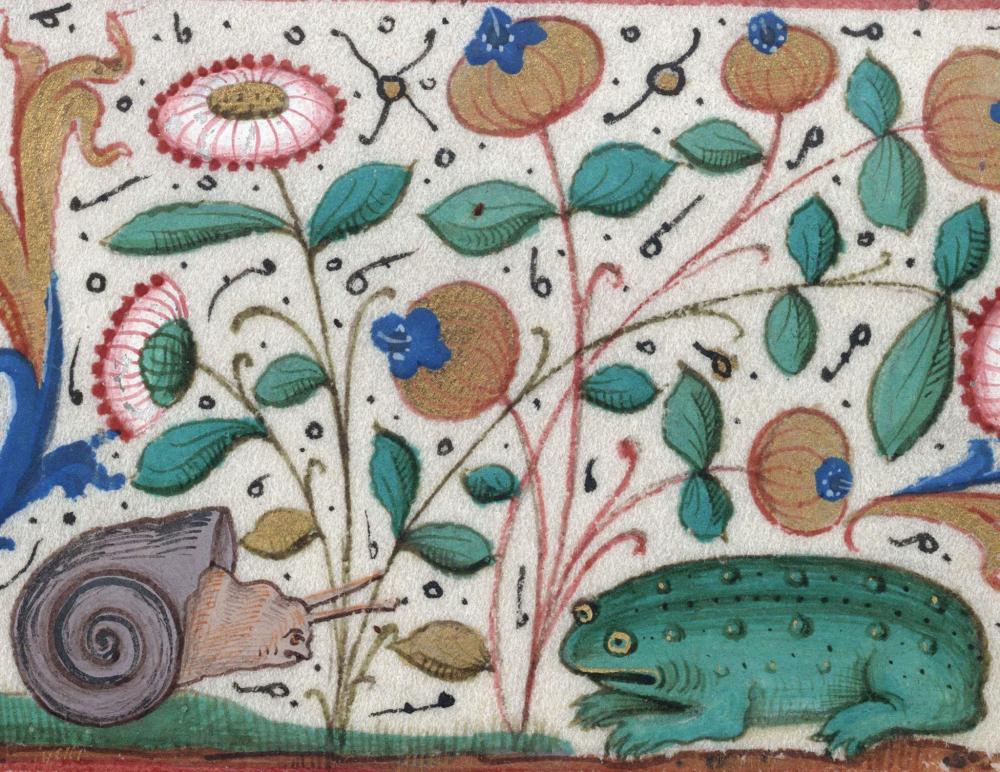
The beauty of the colour green, however, overshadowed the negative associations and it was a popular choice in the illuminated manuscripts of the time. But it was tricky to make. The naturally occurring earth and plant greens were not lightfast and so a mix of the more sturdy primary colours – yellow and blue – gave the best effect. Or, sometimes, verdigris – made from the blue-green rust of copper – was a good alternative but, again, the green colour thus-produced tended to darken over time.

Actually, it was not until the 18th century that a vivid green was produced; and, unfortunately, as it was made by mixing copper with arsenic, it was a dangerous hue, considered responsible for the deaths of many, possibly even Napoleon Bonaparte who had a penchant for green (arsenic-based) wallpaper in his palaces. It was not until the early 20th century that a vivid and safe green was produced. As that great philosopher Kermit the Frog so often said: “It’s not easy being green”.

Hey, hey, windy day

Windy_weather

Today in Sydney there is a wild wind blowing. Trees are down and flights have been cancelled. We only have to look (or venture) outside to see (and feel) the effects of the strong wind but exact measurement of weather components is a sophisticated process in our modern world. Of course, now, accessing those components and getting the latest weather updates and warnings is as simple as a few clicks through to the Bureau of Meteorology but the understanding and interpretation of weather in the Middle Ages was a very different thing. And instruments were limited. It wasn’t until after the Middle Ages – in the late 1500s – that Galileo invented a basic thermometer; and it was 1644 when Galileo’s colleague, the physicist and mathematician, Evangelista Torricelli, invented the barometer for measuring atmospheric pressure. Before that, the medieval people used weather vanes – with the word vane deriving from the Old English word fana meaning flag – for the indication of wind direction, and relied mainly on their own subjective views and experience of what was happening around them for further weather information.

That is, sources for weather data for the medieval period are scarce and historians generally now turn to chronicles and narrative accounts for their insights into climate and its effects. In most instances, objective evidence is limited largely to the observation of physical changes to the local environment brought about by weather and climate events.  For example, the following vivid description of a thunderstorm which took place in northern England in July 1293 is given in Chronicle of Lanercost :

“Early in the morning…we beheld in the east a huge cloud blacker than coal, in the midst whereof we saw the lashes of an immense eye darting fierce lightning into the west; whence I understood that Satan’s darts would come from over the sea. … [and] there began and continued throughout the night over the whole of the west part of the diocese of York, thunder and lightning so prodigious that the dazzling flashes followed each other without intermission, making, as it were, one continuous sunlight. Not only men were terrified and cried aloud, but even some domestic animals – horses, for certain. In some places houses were burnt or thrown down, and demons were heard yelling in the air.”

And, in my opinion, the best ‘potted’ description of the extremes of the seasons is given in the anonymously authored 14th century alliterative poem Sir Gawain and the Green Knight. Here’s an extract, first in the Middle English, and then in translation:

Bot þenne þe weder of þe worlde wyth wynter hit þrepez,
Colde clengez adoun, cloudez vplyften,
Schyre schedez þe rayn in schowrez ful warme,
Fallez vpon fayre flat, flowrez þere schewen,
Boþe groundez and þe greuez grene ar her wedez,
Bryddez busken to bylde, and bremlych syngen
For solace of þe softe somer þat sues þerafter
bi bonk;
And blossumez bolne to blowe
Bi rawez rych and ronk,
Þen notez noble innoȝe
[folio 98r]
Ar herde in wod so wlonk.
After þe sesoun of somer wyth þe soft wyndez
Quen Zeferus syflez hymself on sedez and erbez,
Wela wynne is þe wort þat waxes þeroute,
When þe donkande dewe dropez of þe leuez
To bide a blysful blusch of þe bryȝt sunne.
Bot þen hyȝes heruest, and hardenes hym sone,
Warnez hym for þe wynter to wax ful rype;
He dryues wyth droȝt þe dust for to ryse,
Fro þe face of þe folde to flyȝe ful hyȝe;
Wroþe wynde of þe welkyn wrastelez with þe sunne,
Þe leuez lancen fro þe lynde and lyȝten on þe grounde,
And al grayes þe gres þat grene watz ere;
Þenne al rypez and rotez þat ros vpon fyrst,
And þus ȝirnez þe ȝere in ȝisterdayez mony,
And wynter wyndez aȝayn, as þe worlde askez,
no fage,

But then the world’s weather wrestles with winter:
cold clings to the ground, but clouds rise,
releasing warm rain; rinsing showers
fall to the flat earth; flowers appear,
both field and forest are fringed with green.
Birds busy themselves building, and with brilliant song
celebrate summer, for soon each slope
will rush
                     to bloom with blossoms set
                     in lines luxuriant and lush,
                     while noble notes form nets
                     that fill the forest hush.

Then the summer season when the west breeze blows
and soft winds sigh on seed and stem.
How the green things glory in their urgent growth
when the dripping dew drops from the leaves,
waiting for the warm sun’s welcome glance.
But then Fall flies in, and fills their hearts,
Bidding them be rich, ripe, and ready for winter.
The autumn drought drives up dust
that billows in clouds above the broad earth.
Wild winds whistle, wrestling the sun;
Leaves launch from each limb and land on the soil,
while the green grass fades to grey.
What rose at the first now ripens and rots
till the year has gathered its full yield of yesterdays.
In the way of the world, winter winds

Much nicer description of the weather than we’ll hear on tonight’s TV weather, don’t you think?

The Shape of Things

saint-augustine-hippo-mosaic-front-church-mount-beatitudes-galilee-israel-84554391

Beauty comes in all shapes and sizes. In the Middle Ages, philosophical debate over the concept of beauty was a wide-ranging one, even extending to discussion on geometric shapes. When the debate took such a turn, the fourth-century opinions of St Augustine were never far away. In his text, De Quantitatae Animae, Augustine expounded a theory based on geometrical regularity in which certain shapes of triangles were considered more beautiful than others and a square surpassed a triangle in the beauty stakes. The winner, however, was the circle.

dinosaur egg

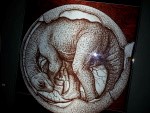
I was prompted to remember this when, on a recent visit to the Australian Museum (Sydney), my attention was taken by a display of models of the dinosaur life-cycle which began with a ‘peep’ inside a dinosaur egg to show the pre-hatched baby tucked into a perfect circle.


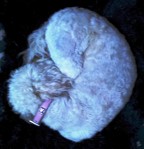
dog circleOn my return home that evening, I was again confronted by a perfect circle in the form of my ‘post-hatched’ dog curled up on her bed in an almost perfect circle. Dinosaurs or dogs, I think Augustine is right: the circle is a beautiful shape.


Yes Power

margery

In 1934, in the dark recesses of an old English family library, a rare fifteenth century manuscript came to light. Scholarly investigation revealed it to be what is now known as The Book of Margery Kempe, the life story of an extraordinary medieval woman who answered “yes” without hesitation when she thought God was calling her. Today, some regard her as a mystic; others as a sick, or attention-seeking woman but, whatever the truth, Margery gives us a surprising lesson in devotion and perseverance.

Margery was born in 1373 in the Norfolk town of King’s Lynn where her father, John Brunham, had been the Mayor for five separate terms. At twenty years of age Margery married John Kempe and within a year of the marriage, had given birth to her first child. She went on to have a further thirteen children but the first birth was especially decisive as, immediately following it, Margery experienced what we now would probably describe as a post-partum psychotic episode but which Margery herself describes as being tormented by devils. Margery explains that the relief from this episode came in the form of a personal visit from Jesus and this unexpected encounter set her on her life’s quest of serving God.

Margery did nothing by halves. Believing that Jesus had appeared to her during her illness, she emerged from her sickbed and began to spend a great amount of time praying, arising at two or three in the morning and making her way to church where she would pray until midday and then again in the afternoon. She confessed to a priest twice and, sometimes, three times a day, in particular seeking forgiveness for an early sin which she had avoided confessing for many years. She adopted stringent fasting and the wearing of a hair-shirt made from the coarse cloth on which malt was dried. It was in these early years, too, that Margery reports receiving the ‘gift of tears’.

This gift, in particular, with its associated crying and wailing at even the mention of Jesus’ name, saw Margery shunned by many who witnessed the extreme behaviour. Such was her disruptive influence that some priests refused to allow her in the church when they were to preach. But Margery persisted in her devotions, feeling that her original “yes” to God was a promise on which she could not renege. She also felt compelled to embark on numerous and extensive pilgrimages and travelled, over several years, to the Holy Land, Rome, Assisi, Santiago de Compostela, Norway and Germany, as well as important pilgrimage sites throughout England. This was an amazing undertaking in the 14th century and even more remarkable for a (sole) woman.

Then, as now, Margery’s travels and general behaviour garner divided opinions on the authenticity of her mystical calling. That is, while there is no doubt of her devotion, her motivation for, and expression of it remain a matter of considerable debate. Putting this debate aside, however, there emerges a wonderful and unexpected consequence of her “yes”…

From The Book we know that, though Margery was illiterate, she managed to dictate her story to an unidentified scribe. Six hundred years after she lived and was almost forgotten, the finding of the manuscript of her life story gave the world the great gift of the first autobiography in English.

Forks in the Road (and other cutlery)

knives_eating

Western table cutlery settings today always feature a knife, fork and spoon, each one with its particular use. Spoons for the soups, sauces; knives for cutting food into manageable pieces; forks for moving the food from plate to mouth. But this organised (and well-mannered) approach is relatively new – at least in terms of human civilisation.

Knives were probably the first of the ‘cutlery set’ to appear. Evidence dates them right back to pre-historic times when sharpened flints, volcanic glass and bones were among the earliest cutting implements in use. With the advent of the Bronze and Iron Ages, knife blades became more sophisticated and, though still used primarily for hunting and as weapons, the knife’s utility was hard to ignore, and smaller versions of it became handy for assisting in eating and cutting in general.

Spoons have been around since the Stone Age too, with shaped stones, shells and hollowed-out animal horns being some of the discoveries that testify to their use.

Forks were known in Greek and Roman times but virtually disappeared from use during the Christian Middle Ages. Some historians have suggested that the fork’s shape was too reminiscent of the devil’s pitchfork but it is more likely that the knife’s versatility – it could be used for spearing food and bringing it to the mouth as well as cutting it – overrode the need to invest too much time and craftsmanship into the fork. And hands were, well, just as ‘handy’ for picking up food (and always ‘on hand’). It seems, however, that the fork did reappear in Western Europe in the 16th century when courtly society deemed that eating was more politely accomplished by digging forks rather than hands into food.

In the Middle Ages all travellers carried their own knife and spoon for eating when staying at an inn on the journey as the innkeeper did not provide guests with cutlery because such useful, well-crafted, and portable items were considered too ‘tempting’ and likely to be stolen by passing strangers: a different take on the “dish ran away with the spoon” in the Hey Diddle Diddle nursery rhyme (which, by the way, seems to date back in some form to medieval times).

One of my favourite ‘literary spoons’ is the runcible spoon in the final part of Edward Lear’s wonderful poem The Owl and the Pussycat:

They dined on mince and slices of quince

Which they ate with a runcible spoon

And hand in hand by the edge of the sand

They danced by the light of the moon, the moon

They danced by the light of the moon.

‘Runcible’ is today said to describe a sort of combination fork, spoon and knife; a fork with a curved section like a spoon, and with three broad prongs, one of which has a sharpened outer edge for cutting. In Australia we might call such an implement a ‘splayd’ or a ‘spork’. Actually, though, Edward Lear made up the word (along with others of his invention) as a whimsical addition to his poem. And cutlery to match the whimsy followed.

Enjoy your dinner!

Cats to Conjure With

cat and mouse

I don’t have to think about it. I admit it: I am a dog person. There’s something about dogs’ joyful optimism and irrepressible enthusiasm for everything from food to a good stick that makes me happy; not to mention their devotion and companionship. And, in truth, I’ve never had a cat as a pet whereas I could not imagine home life without a dog. Nevertheless, I have friends who couldn’t live without their cats and so when I decided to write a blog or two on animals in the Middle Ages, I decided, in the interests of fairness and balance, to start with cats. (Dogs will follow at a later date).

The people of the Middle Ages saw cats in both a positive and negative light. Their biggest “plus” was that cats caught mice, no small mercy in an age that was ridden with rodents. Some medieval commentators, however, compared the way in which cats toyed with the rodents before killing them to the way that the devil played with people’s souls before possessing them completely. From this comparison it was not a large step to believing that the cat, like the devil, could alter its shape and appearance for fair means and foul.  And there was something about the cat’s independence – its disdain for the closely-held belief that God had made animals for the service of humans – that provoked suspicion. And, it’s true that this view resulted in medieval cats being often very cruelly treated.

Fortunately, not everyone shared the suspicion; there is quite a lot of evidence in the literature of the time that shows that many medieval people were very fond of cats.  The Ancrene Wisse, an early 13th century guide for enclosed anchorites, recommends the keeping of a cat, and no other animal. In 14th century Exeter Cathedral had a cat on its payroll at 13 pence per quarter; and in the 1360s that amount was raised to 26 pence per quarter (though, perhaps, indicating an increasing rat problem that called for the employment of a second cat rather than representing a pay rise for the first cat).

A ninth-century monk inserted this poem to his cat in the margin of the manuscript he was working on:

So in peace our tasks we ply,
Pangur Bán, my cat, and I;
In our arts we find our bliss,
I have mine and he has his.

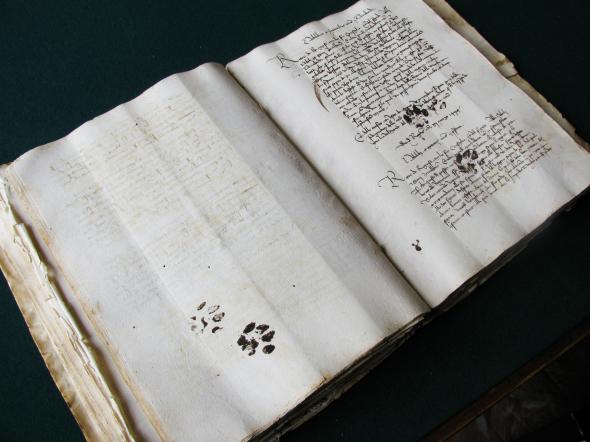
In fact, cats and manuscripts seemed to have gone together in the Middle Ages as can be seen by the paw prints left on a 15th century manuscript from Dubrovnik:

cat prints

And such neat and strong paw prints they are, recorded for posterity. Now, a dog would never have been able to manage that!

Valentine’s Day: Love, Pain and Poetry

wound of love

Ah, love is in the air with Valentine’s Day almost here. And while the commercial aspect of Valentine’s Day is very much a modern phenomenon, the day itself has its origins in the Middle Ages.

True, very early foundations for the day can be found in the ancient Roman fertility Feast of Lupercalia which randomly paired young boys and girls in marriage; but it was the 14th century that gave us our current focus on romantic love. At that time, the West experienced a surge of interest in saints’ and martyrs’ legends. One very popular story was that of St Valentine, a priest of the 3rd century who defied the Roman Emperor Claudius II’s ban on the marrying of Christian couples, and proceeded to perform marriages in secret. For his efforts, St Valentine was executed in 278, and his feast day came to be celebrated on 14th February.  

As it happened, too, the medieval people (particularly of France and England) commonly believed that birds began their mating season on 14th February. In his Parlement of Foules (Parliament of Fowls) the great Geoffrey Chaucer recorded the belief for posterity with the words:

For this was sent on Seynt Valentyne’s day 
Whan every foul cometh ther to choose his mate

And Chaucer wrote a few love poems of his own. One of his best-known is Rondel of Merciless Beauty in which he described the impact of a woman’s beauty on him, and how it feels as if his heart is wounded with love.

There are three parts to this poem, each of thirteen lines. Here is the first part in Middle English and then in modern translation.

Merciles Beaute: A Triple Roundel

Your yen two wol slee me sodenly;
I may the beautee of hem not sustene,
So woundeth hit throughout my herte kene.

And but your word wol helen hastily
My hertes wounde, while that hit is grene,
Your yen two wol slee me sodenly;
I may the beautee of hem not sustene.

Upon my trouthe I sey you faithfully
That ye ben of my lyf and deeth the quene;
For with my deeth the trouthe shal be sene.
Your yen two wol slee me sodenly;
I may the beautee of hem not sustene,
So woundeth it throughout my herte kene.

Rondel of Merciless Beauty

Your two great eyes will slay me suddenly;
Their beauty shakes me who was once serene;
Straight through my heart the wound is quick and keen. 

Only your word will heal the injury
To my hurt heart, while yet the wound is clean –
Your two great eyes will slay me suddenly;
Their beauty shakes me who was once serene. 

Upon my word, I tell you faithfully
Through life and after death you are my queen;
For with my death the whole truth shall be seen.
Your two great eyes will slay me suddenly;
Their beauty shakes me who was once serene;
Straight through my heart the wound is quick and keen. 

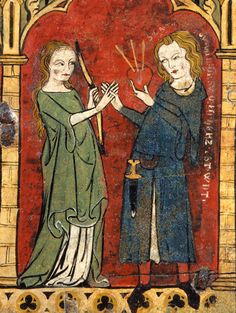
The juxtaposing of love and pain was common in medieval poetry; and today we find that same blend in poetry, literature and films. Such pairing is, of course, the natural expression of the human experience of love and loss but, today, the pain is regarded as coming more at the end of a relationship than at the beginning. In the Middle Ages, and following the much earlier Roman mythological view,  Cupid (and his mother Venus) were presented as the initiators of love (and lust). Cupid would aim his bow and shoot an arrow not into the heart of the soon-to-be-lover but into his eye; that is, the object of his admiration was first pleasing to the eye (in a “love at first sight” way). After that, the heart, and the will, would acquiesce and act on the desire. You’ll notice that Chaucer plays with this “eye-heart” connection throughout the Merciless Beauty poem, and he also highlights the “wounding” and “slaying” aspect. This is especially interesting because “rondel” had another meaning in the Middle Ages. Then, a rondel was also a dagger with a very narrow and needle-pointed blade, perfect for thrusting into another’s heart for a swift and accurate kill.

Let’s hope you get all the love, and none of the pain, on this 14th February.

Perchance to Dream

dreams

Dreams, as we all know, are complicated. Sometimes they are pleasant, sometimes terrifying, but always they leave us with fleeting and fractured impressions of our sleeping subconscious after we wake from them. Interest in dreams goes back a long way into our human history; and throughout the ages there has been no shortage of authors putting quill to parchment for the purpose of exploring the dream-state more deeply.

Cicero, the great Roman orator and statesman, and consul of Rome in 63BC, is among the many who wrote about dreams. In fact, his Somnium Scipionis (The Dream of Scipio) became one of the most influential works on dreams for later medieval writers. Cicero’s story of the dream of Scipio Africanus – in which the subject’s grandfather appears to him and gives him insights into such heady topics as cosmology and the immortality of the soul – made such an impression on the early medieval writer, Macrobius, that he wrote a detailed commentary on Scipio’s dream, developing the elaboration into a classification method for dreams in general.

Macrobius’s method distinguished 5 types of dream. The first two types (nightmare and apparition) he declared as ‘insignificant’ because he believed them to be non-predictive/non-prophetic (and, therefore, of no practical use to one’s present or future life). Such dreams, he said, were brought about by day-time anxiety or stress or, in particular, over-indulgence in the wrong kind of food and drink.

The next three types in the classification, however, were of great significance:

  • The somnium or enigmatic dream in which strange shapes and symbols represent important meanings that must never be ignored but always carefully interpreted.
  • The visio or prophetic visionary dream which is a clear glimpse or insight into what is to come.
  • The oraculum in which someone of importance and/or great wisdom (from the past or present, dead or living) appears to the dreamer to impart information or advice.

Such credence was given to Macrobius that, in the later Middle Ages, a whole genre of dream-vision poetry developed with his classifications as the base and inspiration. Great medieval authors such as Chaucer (who not only wrote many dream-vision poems but actually mentions Macrobius’s Scipio in at least three of them) and Guillaume de Lorris (Romance of the Rose) were masters of the genre. Even Dante’s epic The Divine Comedy is a vision of the world beyond death.

Today, of course, most writers are cautious about employing the dream device but, for medieval authors, it was regarded as a skilful way of bringing together the worlds of reality and imagination. Then, too, the division between the material and the spiritual was much more fluid, less stringently applied than in our own matter-of-fact time. Now, the dream (and even sleep itself) has been down-graded to a distant second-place behind our ‘real lives of busyness’. There is little time to ponder our dreams when all waking moments are taken up by the bright screens of modern technology.

Something to think about as you fall asleep tonight … unless, of course, you’ve over-eaten beforehand!

A Wait Problem

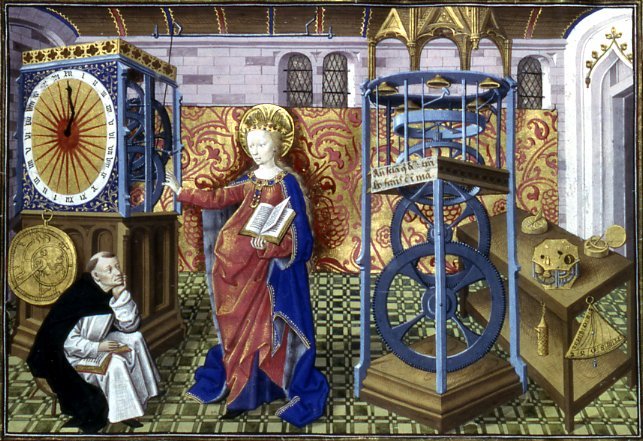
L'Horloge de Sapience (the Clock of Wisdom) from about 1450

As a society, we Australians are not very good at waiting. Being at the end of a long queue in the supermarket, or at the petrol station, or the ticket office is enough to send us into an agitated frenzy. Trolley rage, road rage, crowded train rage – you name it, we rage about it. Busyness is considered a virtue and anyone who is not ‘flat out’, head-down, tail-up’, ‘haven’t got a minute’ is obviously not pulling their weight in this country with some of the longest working hours in the world. Recently, a Sydney University study showed that one in five Australian workers puts in at least 50 hours a week while, overall, full-time employees work an average of 44 hours per week, placing us near the top of the hours-worked pile among the OECD countries.

Last year, Australians clocked up over 2 billion hours of unpaid overtime. The situation has reached such a fever pitch of activity that, for the past several years, The Australia Institute has nominated a day in late November as National Go Home on Time Day www.gohomeontimeday.org.au . And guess what? Today is the day – 22nd November, 2017.

Of course, once we get home, there’s little likelihood that we’ll be any less busy than we are at work as we rush to complete household chores, to fulfill social engagements and family commitments. Yes, we know what we should be doing: taking time to smell the roses; being aware; living in the present moment

But just what IS a ‘present moment’. Some of the great mystical writers of the Middle Ages sought to quantify the notion because they were concerned with entering wholeheartedly into a contemplative state. They recognised that merely being IN the world was to be in a state of constant distraction, so many of them chose to separate themselves from the distractions by seeking out isolated places where silence could surround them. Others acknowledged that unavoidable and constant distractions were part and parcel of being alive and so tried to work within the limitations. The fourteenth-century Cloud of Unkowning author* took a more lateral view, advising his readers that the work of contemplation was “the shortest work that can be imagined”. For him, that ‘shortest’ time was “no longer or shorter than one athomus”.  To the medieval understanding an athomus was the smallest quantity of time, indivisible and almost incomprehensible. It was approximately equal to one-sixth of a second and, therefore, the Cloud author is speaking of the attainment of the Divine as being virtually instantaneous. It is our modern-day equivalent of finding and experiencing God/Peace/Love in the absolute present, in every moment. The Cloud author further reminds his audience that “[we] shall be asked how all the time given [to us] has been spent … [for] nothing is more precious than time. In one little moment, heaven may be won and lost … [and] time is made for man, not man for time.” That is, the Cloud author stresses the importance of time, the necessity to use it effectively, and the infinite possibilities that time offers in each and every moment.

So, don’t forget to go home early today and, when you get there, take an athomus or two to appreciate all the possibilities of the moment.


*The actual author of the mystical text The Cloud of Unknowing is, ironically, unknown; hence he is usually referred to as “the Cloud author”.


Kangaroo Court of Australia

Why rent a lawyer when you can buy a judge

Dally Messenger III

Social Integrity - Civil Celebrants - Politics and Current Affairs

Quodcumque - Serious Christianity

“Whatever you do, do it with your whole heart.” ( Colossians 3: 23 ) - The blog of Father Richard Peers SMMS, Director of Education for the Diocese of Liverpool

On Research

Age Concern New Zealand

Notes from the U.K.

Exploring the spidery corners of a culture and the weird stuff that tourist brochures ignore.

Zombie Salmon (the Horror Continues)

A blog about Horror fiction, Horror writing, and Horror criticism...a continuation of The Horror at Open Salon

Causeway Lit

An online literary journal

From my Mind

From My Mind: You can call this site as a personal blog or personal dairy: whatever it's I wanna call this site as my World. Because here, I post whatever it reaches my mind.

SHINE OF A LUCID BEING

Astral Lucid Music - Philosophy On Life, The Universe And Everything...

David Palethorpe

The thoughts, dreams and ideas of an insignificant speck of humanity in the Universe 😀

Ailish Sinclair

Stories and photos from Scotland

Unsophisticated Articles

A learning tool through experience

wake up and smell the humans

The website of Sean Crawley

The Reluctant Retiree

Stories from Garrulous Gwendoline - a baby boomer surviving retirement

The Immortal Jukebox

A Blog about Music and Popular Culture

KAGHAMAR

L'art de la Bible