

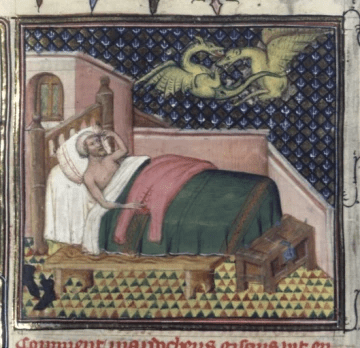
There’s a heatwave in Sydney at present. And sleeping soundly – which, for me, is often elusive at the best of times – is difficult as we toss and turn in the merciless humidity that grips until the early hours of a new day. In these conditions, dreaming is a distant memory but it is generally held that dream-filled sleep is essential to our overall wellbeing . Dreams, as we all know, are complicated. Sometimes they are pleasant, sometimes terrifying, but always they leave us with fleeting and fractured impressions of our sleeping subconscious after we wake from them, and a quiet knowledge that there is something more going on with us, beyond our waking perceptions.
Interest in dreams goes back a long way into our human history; and throughout the ages there has been no shortage of authors putting quill to parchment for the purpose of exploring the dream-state more deeply.
Cicero, the great Roman orator and statesman, and consul of Rome in 63BC, is among the many who wrote about dreams. In fact, his Somnium Scipionis (The Dream of Scipio) became one of the most influential works on dreams for later medieval writers. Cicero’s story of the dream of Scipio Africanus – in which the subject’s grandfather appears to him and gives him insights into such heady topics as cosmology and the immortality of the soul – made such an impression on the early medieval writer, Macrobius, that he wrote a detailed commentary on Scipio’s dream, developing the elaboration into a classification method for dreams in general.
Macrobius’s method distinguished 5 types of dream. The first two types (nightmare and apparition) he declared as ‘insignificant’ because he believed them to be non-predictive/non-prophetic (and, therefore, of no practical use to one’s present or future life). Such dreams, he said, were brought about by day-time anxiety or stress or, in particular, over-indulgence in the wrong kind of food and drink.
The next three types in the classification, however, were of great significance:
- The somnium or enigmatic dream in which strange shapes and symbols represent important meanings that must never be ignored but always carefully interpreted.
- The visio or prophetic visionary dream which is a clear glimpse or insight into what is to come.
- The oraculum in which someone of importance and/or great wisdom (from the past or present, dead or living) appears to the dreamer to impart information or advice.
Such credence was given to Macrobius that, in the later Middle Ages, a whole genre of dream-vision poetry developed with his classifications as the base and inspiration. Great medieval authors such as Chaucer (who not only wrote many dream-vision poems but actually mentions Macrobius’s Scipio in at least three of them) and Guillaume de Lorris (Romance of the Rose) were masters of the genre. Even Dante’s epic The Divine Comedy is a vision of the world beyond death.
Today, of course, most writers are cautious about employing the dream device but, for medieval authors, it was regarded as a skilful way of bringing together the worlds of reality and imagination. Then, too, the division between the material and the spiritual was much more fluid, less stringently applied than in our own matter-of-fact time. Now, the dream (and even sleep itself) has been down-graded to a distant second-place behind our ‘real lives of busyness’. There is little time to ponder our dreams when all waking moments are taken up by the bright screens of modern technology.
Something to think about as you fall asleep tonight … unless, of course, you’re stuck in a heatwave, or you’ve over-eaten beforehand!
 Carmel Bendon
Fascinating about Macrobious
LikeLike
Yes, Macrobius is interesting, tapping into the Ancient world’s emphasis on the importance of dreams. The Medieval world followed suit, and now we’re just as fascinated with dreams and their meanings.
LikeLiked by 1 person
I am a prolific dreamer, and some carry through to the waking hours. For the first time ever, Trump appeared in a lead role in a recent one as a part of my household or wider circle, not in a presidential candidate role. That may be one of Macrobius’s nightmares!
When I was younger I had several prescient dreams, one that provided much comfort when the events actualised as I was able to relax, knowing what would happen next and that I would be eventually in safe hands. But those seem to have left me now. Maybe there is no longer need for warnings?
I used to often dream of self-propelled flying, until I did a skydive and experienced the sensation first-hand in the freefall section. I’ve never had that dream since. Bit of shame. I quite liked those.
Sometimes I struggle to remember if a memory is real, or something I dreamt. Other times, I know the dream is simply sifting through the day’s events and deciding which need long-term storage. Where my mind goes when technically my body is shut down has always been a fascination for me. But I’ve never felt inclined to jump up and write a poem about it 🙂 In fact, sometimes I am exhausted after a night’s “sleep”. Things can get very busy and I travel widely.
LikeLike
Thank you so much Gwendoline for this insight into your rich dreaming life. You’re obviously very attuned to your dreams. And what a variety of subject matter they contain. Some people can’t remember any of their dreams, and even declare that they never dream. Sometimes I’ll wake, determined to remember the dream I’ve just had, but it disappears with the opening of my eyes. On the other hand, there are dreams that I had many years ago, even in childhood, that I can recall easily (and even ‘re-dream’ them if I make the firm intention to do so just before I doze off).
LikeLiked by 1 person
The childhood dream that springs to mind was a repetitive one. I must have had it dozens of times. My ten-years older brother, our mother, and me would be coming home on the bus and get off at the end of our street; except my brother would fail to get off, and be carried on to an unknown destination, with my mother distraught, and young me, well, meh. He’s gone.
My poor brother was clearly not my favourite person at that time!
LikeLike