


It’s Spring and everything in the garden is blooming. In Sydney the winters are not harsh but we still appreciate the lengthening light, the warmer days, and the signs of nature renewing itself that come with the change of season.
In medieval times, someone who watched and understood the seasonal cycle of renewal  was the great visionary, Hildegard of Bingen. Born in Germany’s Rhineland in 1098, Hildegard was not only a prominent religious figure of her day but also – as her considerable writings and works demonstrate – an expert on natural science, medicine and herbal treatments, cosmology, poetry and music. Further testament to her influence is that many of her writings (and musical compositions) survive to the present day. Hildegard’s works are not ‘easy reads’ but a lot of her ideas resonate with our current interests, particularly our concerns over climate change and caring for our planet.
Don’t be mistaken: Hildegard was a woman of her time and, it seems, a very strong personality. She had an extraordinary intellect and pulled no punches when it came to asserting a theologically precise view of the medieval Church; but, she also had a deep reverence for, and an amazing insight into, the beauty and order of creation. So powerful are Hildegard’s expressed views on the importance and dignity of all creation that the coining of the term viriditas (greening/greeness) is frequently, and somewhat mistakenly, attributed to her. In fact, earlier theologians such as St Augustine had made mention of viriditas but it is appropriately and particularly associated with Hildegard because of the new and interesting way that she interpreted and applied the concept. For Hildegard, viriditas was the reflection of God’s goodness and beauty in everything in the natural world. It stood for vitality, fertility, fruitfulness and growth; in essence, all the things that we now associate with the greenness of nature. For Hildegard, viriditas was also synonymous with physical and spiritual health. Similarly, for us today, ‘greenness’ and the seasonal renewal of the natural world are signs that the Earth is healthy and flourishing.
Hildegard was canonised (becoming St Hildegard) by Pope Benedict XVI in May 2012 and, though it took the Church nearly 900 years to acknowledge her remarkable contributions, the canonisation is strangely timely as it coincides with our efforts to come to terms with the ravages of a changing climate. Hildegard of Bingen has a lot to teach us.

 which mariners can “come ashore”. Once there, Caxton explains that it is not unusual for the seamen to light a fire on which to cook their food. However, the heat of the cooking fire eventually distresses the whale enough that he must dive down under the water to cool himself, thereby taking all the mariners with him to their death. The symbolic interpretation of this is that the whale is as deceitful as the devil, luring men to death (spiritual and physical) when they fail to be alert to the deception, and fall for easy and comfortable options.


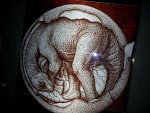
 On my return home that evening, I was again confronted by a perfect circle in the form of my ‘post-hatched’ dog curled up on her bed in an almost perfect circle. Dinosaurs or dogs, I think Augustine is right: the circle is a beautiful shape.

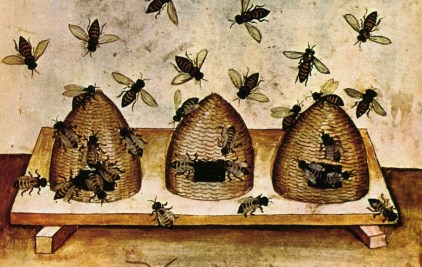
 Beehives were made of pottery or wood or wicker, and generally cone-shaped. In colder climates, and in the winter months of more temperate zones, the hives were layered with straw to keep the bees warm (and alive). Harvesting of the bees’ honey and other products was effected by fumigating the hives with thick smoke. This method saved the beekeeper from being stung but, unfortunately, killed the bees so that new swarms needed to be sourced regularly.


 Carmel Bendon