
A Wait Problem

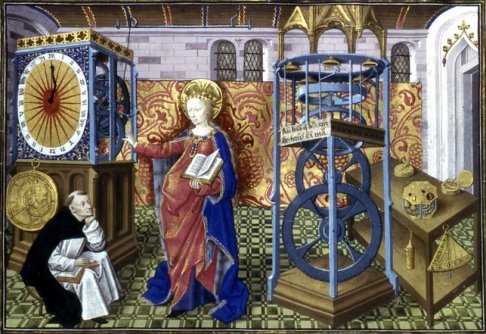
L'Horloge de Sapience (the Clock of Wisdom) from about 1450

As a society, we Australians are not very good at waiting. Being at the end of a long queue in the supermarket, or at the petrol station, or the ticket office is enough to send us into an agitated frenzy. Trolley rage, road rage, crowded train rage – you name it, we rage about it. Busyness is considered a virtue and anyone who is not ‘flat out’, head-down, tail-up’, ‘haven’t got a minute’ is obviously not pulling their weight in this country with some of the longest working hours in the world. Recently, a Sydney University study showed that one in five Australian workers puts in at least 50 hours a week while, overall, full-time employees work an average of 44 hours per week, placing us near the top of the hours-worked pile among the OECD countries.

Last year, Australians clocked up over 2 billion hours of unpaid overtime. The situation has reached such a fever pitch of activity that, for the past several years, The Australia Institute has nominated a day in late November as National Go Home on Time Day www.gohomeontimeday.org.au . And guess what? Today is the day – 22nd November, 2017.

Of course, once we get home, there’s little likelihood that we’ll be any less busy than we are at work as we rush to complete household chores, to fulfill social engagements and family commitments. Yes, we know what we should be doing: taking time to smell the roses; being aware; living in the present moment

But just what IS a ‘present moment’. Some of the great mystical writers of the Middle Ages sought to quantify the notion because they were concerned with entering wholeheartedly into a contemplative state. They recognised that merely being IN the world was to be in a state of constant distraction, so many of them chose to separate themselves from the distractions by seeking out isolated places where silence could surround them. Others acknowledged that unavoidable and constant distractions were part and parcel of being alive and so tried to work within the limitations. The fourteenth-century Cloud of Unkowning author* took a more lateral view, advising his readers that the work of contemplation was “the shortest work that can be imagined”. For him, that ‘shortest’ time was “no longer or shorter than one athomus”.  To the medieval understanding an athomus was the smallest quantity of time, indivisible and almost incomprehensible. It was approximately equal to one-sixth of a second and, therefore, the Cloud author is speaking of the attainment of the Divine as being virtually instantaneous. It is our modern-day equivalent of finding and experiencing God/Peace/Love in the absolute present, in every moment. The Cloud author further reminds his audience that “[we] shall be asked how all the time given [to us] has been spent … [for] nothing is more precious than time. In one little moment, heaven may be won and lost … [and] time is made for man, not man for time.” That is, the Cloud author stresses the importance of time, the necessity to use it effectively, and the infinite possibilities that time offers in each and every moment.

So, don’t forget to go home early today and, when you get there, take an athomus or two to appreciate all the possibilities of the moment.


*The actual author of the mystical text The Cloud of Unknowing is, ironically, unknown; hence he is usually referred to as “the Cloud author”.
 

Mirror, Mirror!

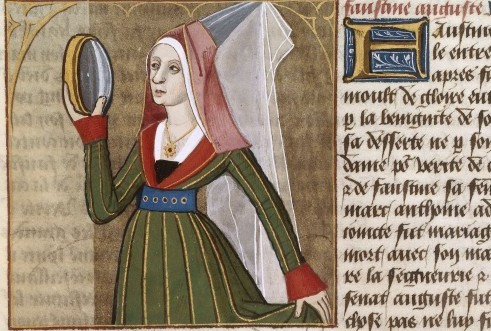
mirror

We all remember the magic mirror belonging to the evil queen in the fairytale, Snow White. Each day the queen would position herself in front of the mirror and ask, “Mirror, mirror, on the wall, who is the fairest of us all?” And the mirror would reply, “You are, O Queen.” The queen would be reassured for the moment, content in the mirror’s lie and its acquiescence to her vanity.

                Throughout history, the mirror has been one of the most prevalent and potent metaphors for the folly of human vanity. One of the foundational Western myths, for example, is the story of Narcissus who fell helplessly in love with himself when he discovered his reflection in a woodland pond. So taken was he with the beauty of his own image, he could not leave the pond and so died there.

Today we, too, seem to be obsessed with our own images. We wouldn’t think of leaving the house without first checking ourselves in the mirror. Lifts in buildings have mirrored walls so we can pass the time by looking at ourselves as we ascend or descend. There are mirror apps for our phones. And our mobile phones are the new mirrors, providing us with the instant ‘selfies’ that we can enhance (or delete) before sharing them with the world.  We spend countless billions on lotions and potions in attempts to beautify ourselves and to ward off the aging process. Beauty and youth are idealized and idolised in glossy magazines, on the big and small screen, and across social media. And the way to happiness is often touted as being as easy as a few deft swipes of the plastic surgeon’s knife. The idea is that we’re only as worthwhile as our outward appearance. If we don’t look good, we cannot be happy. In this way, the mirror is powerful because we allow it to have power.

And its power over humans started a long time ago. Archaeologists have found evidence of the earliest mirrors being simply polished surfaces of natural materials – rocks like obsidian, for example – which could reflect back an image, albeit a hazy one. With time, the crafting of metals – copper, silver, gold – gave the self-viewer a slightly clearer idea of him/herself but it was still a rudimentary reflection. The glass mirror – the closest ancestor of our contemporary mirrors – is recorded from Roman times but it was really during the Middle Ages that the quality of glass became good enough to return a clear reflection. Around that time, the manufacture of a much smoother glass enabled a relatively blur-free surface to be achieved and its reflective ability was increased by backing the glass with a metal such as gold leaf or a silver-mercury combination.

The medieval mirror par excellence was the work of Venetian glassmakers on the island of Murano. Their backing material of choice was kept secret for many decades but it was known to include mercury in the gilding process which, of course, made the final product ‘problematic’. Still, that didn’t dampen the general enthusiasm for mirrors (though, of course, their cost made them a luxury item for the wealthy only). After that, the reflective quality continued to improve over the centuries as production methods advanced the clarity of glass.

As far as the mirror was concerned, there was no looking back!

Author! Author!

venerableBede - Copy

I must confess that I’ve always had quite a bit of sympathy for the biblical ‘Doubting Thomas’.** It seems such a very human reaction to me to express incredulity at a man rising from the dead and to want to verify the event by reliance on one’s own senses. We doubt many things that we haven’t seen with our own eyes or perceived with our other senses. We are a society that demands proof as a matter of course. Business cannot function without written contracts; academic research builds on earlier (written) research results; the legal system insists on proof before a conviction can be recorded. We wouldn’t dream of taking a financial institution’s word as to our account balance – we must check the statement ourselves. MRIs and other technologically complex tests are necessary to probe and verify our illnesses. We cannot leave the country without a passport; nor can we be considered to even ‘exist’ without a birth certificate; and we’re only officially ‘dead’ when the Death Certificate is entered into the public record.

This wasn’t always the case. The Venerable Bede, for example, completed the writing of his Ecclesiastical History of the English People in 731. Bede was born in Northumbria in about 673 AD. At the age of seven he was given by his parents into the care of the Benedictines at the monastery of Saint Peter in Wearmouth in north-east England. In 682, Bede was transferred to a joint-foundation at Jarrow and there he remained as a monk until his death in 735. In the Preface to his history, Bede assures his readers that they can trust in all that he has written because, he states, “I am not dependent on any one person, but on countless faithful witnesses who either know or remember the facts”. That is, for Bede, the authenticity of his history comes not only from earlier written accounts but also from a variety of trusted oral and traditional sources. It is Bede’s words, and the words of those he trusted, that are presented as the impeccable credentials on which the veracity of his work rests.

In the High Middle Ages, too, the importance of trusting the words (written and spoken) of others found full realisation in the writing practice of NOT being seen to be original and creative but, rather, of being regarded as giving due acknowledgment to those who had gone before, of building on the firm foundations of the insights and achievements of previous generations. Bernard of Chartres’ saying (often incorrectly attributed as having its origin with Isaac Newton – though Mr Newton certainly said those words too), “We are as dwarves on giants’ shoulders …” is emblematic of the time which gave us the word ‘author’ from the Latin ‘auctoritas’ meaning ‘authority’. That is not to suggest, of course, that the great medieval writers were not creative; in fact, authors such as Geoffrey Chaucer and Marie de France (more of these in later posts) turned narrative conventions upside down to give us stories that are as fresh and relevant today as they were at their time of composition. And nor is it to suggest that the writings of the past centuries were all ‘true’ and utterly ‘honest’ representations of people’s lives and thoughts. The art of Rhetoric has been around since at least the days of the Ancient Greeks and part of the ‘authority’ that was passed on from them to the Western authors of the early and later Middle Ages was the insight that words are slippery, and can exert influence, menace, confusion as well as relay information and inspiration. 

The situation is no different today. So, what to do? The doubt of Thomas, the trust of Bede, the creative slipperiness of Chaucer? As a writer I’m opting for the third option; but in my everyday life I’m taking the middle ground: open mind and open heart with the occasional pinch of scepticism.


**Thomas, called the Twin, who was one of the Twelve, was not with them when Jesus came. When the disciples said, “we have seen the Lord”, he answered, “Unless I see the holes that the nails made in his hands and can put my finger into the holes they made, and unless I can put my hand into his side, I refuse to believe” (John 20: 24-29).

Playing Chicken

Chickens

My neighbours have built a chicken coop (‘a chook shed’ as we Aussies say) in their suburban backyard with high hopes of having fresh eggs for breakfast for many years to come. It’s a good plan and one to which people the world over have subscribed for many, many centuries. Today’s domesticated chickens are, apparently, descended from the Red Jungle Fowl of South Asia. The Romans are thought to have brought chickens to Britain with them and it’s the descendants of that Roman poultry that have become the focus of some intense archaeological studies in the past few years. What particularly drew the archaeologists’ attention was the discovery of substantial increases in the quantity of chicken remains that could be dated between the 9th and 12th centuries. Though chickens had been an easy and popular feature of even the humblest farms prior to, and following those centuries, several studies noted that the 9th – 12th century increase correlated with a surge and expansion of the farming and fasting practices of the Benedictine monks: they abstained from the eating of meat from quadrupeds but, as birds (and their eggs) were not considered to be ‘meat’ – having only two legs –  the raising of chickens on their monastery lands was a good way of feeding the monks and honouring their fasting obligations. The spread and influence of the Benedictines in these centuries very soon saw their fasting practices adopted by large portions of Christian society. A simple case of chicken and egg.

It got me thinking about a chicken and egg experience of my own.

One year, in an effort to give our city-born-and-bred daughters a taste of ‘rural life’, we hired a farmhouse cottage for the July school holidays. The cottage was ‘rustic’ to say the least, with bare, unsealed floors, lumpy beds and no heating except for a wood-burning stove in the little living room. This left the kitchen and bedrooms bitterly cold in the Oberon winter. Still, we reasoned that frosty breath in the morning, and icicles on the windows were part of the adventure. A blanket of snow in the surrounding yard was also a bonus. In the yard, too, much to the delight of three little girls, was a chicken coop with one – and only one – fat, red hen. The farmer, greeting us on our arrival, told the children that the hen’s name was ‘Henrietta’ and, pointing them to a bag of chicken feed, he said that they could feed her each morning and evening. They were beside themselves with joy and, as soon as the farmer took his leave, they were in the coop with Henrietta.

“Be gentle with her,” I instructed.

“We will, Mummy, but we just love her. Do you think she’ll lay some eggs?”

“Well, I certainly hope so,” I replied. “That’s what hens do.” What I, as a city-born-and-bred mother did not know, however, was that chickens don’t lay very reliably when the mercury is sitting below freezing most of the day and night.

Now, whether it was indeed the freezing weather, or the hen’s nervousness at being so greatly loved by three little girls, the first week passed without my daughters discovering a single egg in Henrietta’s coop.

“Mumma, you said she’d lay eggs,” they moaned as they tramped despondently back into the cottage empty-handed again.

Our days at the farm were ticking by and, with only four mornings left, I decided to take the egg production business into my own hands. After the girls were asleep that night, I crept out to the chicken coup with a torch in one hand, and a fine, brown egg from a carton purchased at the local supermarket in the other, and I carefully placed the egg next to a somewhat alarmed chook.

The next morning the girls made their way doggedly to the hen-house, mumbling that it would be another waste of time. I smiled quietly to myself as I heard their excited cries.

“Mummy, Mummy, look. Come quickly,” they shouted.

I ran out, arranging a fake look of surprise on my face as I went, but my pretence turned to real surprise when the girls stood in front of me with an egg each in their hands.

“Mummy, Henrietta’s laid three eggs,” they said, proudly holding up their discoveries for my inspection. There, in front of my eyes, were three brown eggs – and only one of them was store-bought.

Over the remaining days of our farm stay Henrietta managed to produce two eggs each morning, without any prompting from me and, nearly twenty years on, Henrietta lives on in the memories of my daughters – and of me, especially – as a chook who could take a hint. Like most of us, all she needed was a little encouragement.

Raising Specks to the Spectacular

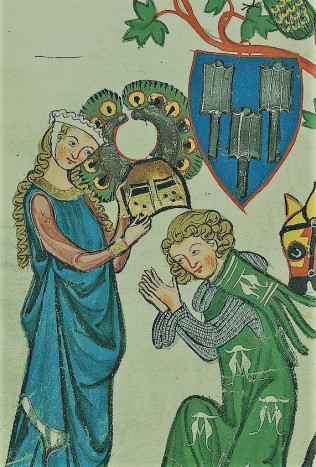
Meister_der_Manessischen_Liederhandschrift_001

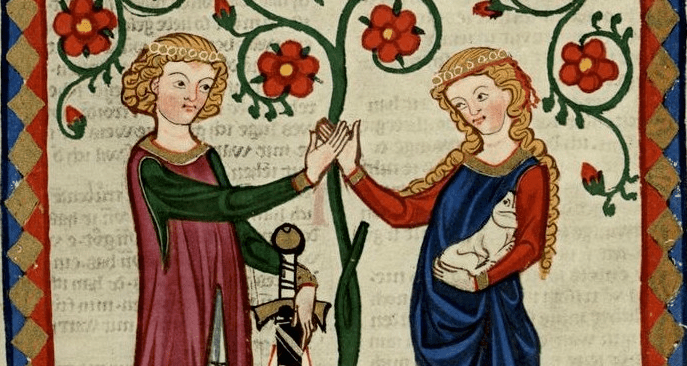
O the dignity of that small speck of human dust
Taken by the jewel of heavenly excellence

To raise us from the clay of earth to heaven’s height
                                        (Gertrude the Great 1256-1302)

Gertrude the Great was a nun and mystic in the great Benedictine abbey of Helfta in Saxony. There she was one of a group of medieval women who later came to be known as “the scholars of Helfta” because of their extraordinary writings and mystical experiences. Gertrude’s prayer brings together two paradoxical aspects of our human existence – our insignificance in the grand scheme of things, and our dignity. Her lovely metaphor for each of us as “that small speck of human dust” is even more relevant today than it was when Gertrude composed her poem in the late 13th century.

Last time I checked, the world’s current population is around 7.5 billion people, and increasing at a rate of about 3 people per second. In the (population) scheme of things, a human individual is very insignificant indeed. And if that isn’t sobering enough, consider the fact that our Sun is only one of billions of stars in billions of galaxies in the universe. The total number of stars is calculated to be greater than all the grains of sand on Earth. Our Milky Way galaxy alone has about 400 billion stars. In effect, we’re a speck on a speck (Earth) in a spectacularly vast universe.

The 14th century English woman, Julian of Norwich (another great mystic), was also given a view of Earth’s smallness and insignificance in one of her (what she termed ) “Revelations of Divine Love”. In her writings on those profound revelations she explains that she was shown “a little thing, the size of a hazel nut, lying in the palm of my hand”. As she looked at it, she wondered what it could be and she was answered that “It is all that is made”. Julian admits that she was amazed that all of creation was so inconsequential and she was anxious about having the responsibility of holding it in her hand because she thought that “it might suddenly have fallen into nothingness because it was so little”. Julian’s anxiety was soothed when she was told that creation endures, and will continue to endure, because God loves it. It is a simple statement and yet it’s possibly the only answer that makes any sense to us: love endures.

We cannot hope to truly comprehend the vastness and complexity of our universe but we can understand, from our own everyday human experience, what it is to be loved and to love ourselves and others. Of course, to truly love others we must acknowledge their humanness – the positive and negative attributes of the personality, the annoying habits, the inconsistencies, the humour and kindness, the bad temper, the fears, the thoughtfulness, the failings as well as the successes. In our enduring love for others, we raise them up in our own estimation and, as a consequence, they are also raised in their own view  – from specks to spectacular. So, like Gertrude the Great, Joe Cocker was onto something in his song “Love Lifts us up Where We Belong”.


A Vine in Winter

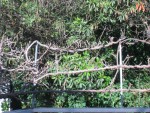
vine in winter

The wisteria vine that surrounds my home’s back deck is smooth and bare right now.  Looking at it, I find it hard to imagine the shock of white blooms that will burst forth from it in Spring, and then the lush green foliage that will completely cover the bareness in Summer. The renowned early 20th century writer and researcher into mysticism and mystics, Evelyn Underhill, defines mysticism –  in its simplest terms – as “seeing things differently” and I often remember that little definition when I look at my wisteria vine. Beneath its nakedness the vine is full of life, full of potential, that will flower when the conditions are right.  Great thinkers throughout history have dared to see things differently. Sometimes, they have had to wait a long time to be vindicated. Galileo is a good example. He dared to see the medieval cosmos in a very different way, going so far as asserting that, contrary to the firmly held view of the time, the Earth revolved around the Sun and not vice versa. Persecuted by the Inquisition for his views, he was finally exonerated in 1992 when Pope John Paul II officially declared that Galileo had been correct all along.

The medieval view of cosmology basically rested on the theories of Ptolemy and Aristotle.  In this view the Earth was at the centre and was surrounded by the seven progressively larger concentric spheres of the Moon, Mercury, Venus, the Sun, Mars, Jupiter and Saturn. (And, by the way, this is where we get our expression, “in 7th heaven”). Beyond the planetary spheres were, firstly, the stellatum – the area of fixed stars – and then the primum mobile which was the boundary of the physical universe. In the medieval, Christianised version of cosmology, beyond this outermost sphere (and thus, literally outside the universe) was the Empyrean or Heaven, the place of God.

Of course, we are very unlikely to have the visionary and intellectual insights of Galileo but we can at least try to be more open in our approach to life. We can strive to “see things differently” by, in particular, accepting others’ points of view; we can try to step outside our comfort zones and reach out to people whom we might ordinarily avoid; we can embrace some new ideas and new technologies and see them as opportunities rather than threats. We can choose to grow rather than to stagnate and, then, to let our potential flower when the time is right. And, with any luck, we won’t have to wait as long as Galileo to harvest the fruits of our “new view”.

As Above So Below

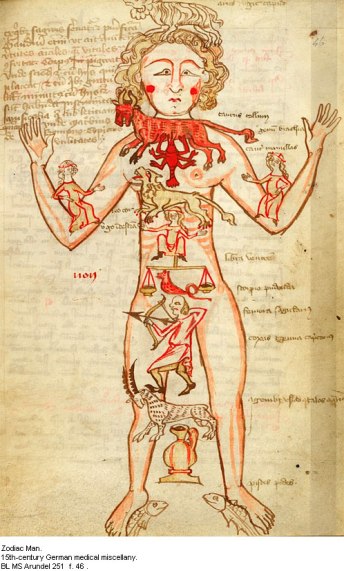
zodiac-2

One of the most read sections in today’s magazines is the Horoscope. This suggests that even if we deny a belief in the direct influence of the stars and planets on our daily lives, we at least entertain the possibility that people of the same star sign might share some broad personality characteristics.

In the Middle Ages no such ambiguity existed. Everything in the world was understood to be connected to everything else in some way, and the idea of “as above, so below” held sway. What existed in the heavens above, existed in the world below. As everything, everywhere, was thought to be composed of various combinations of the four elements – earth, fire, water and air – when something moved or changed in the heavens above, human bodies reacted below. Medieval people had witnessed the effects on the phases of the moon on the Earth’s tides so why wouldn’t the body’s elements similarly respond? And respond even more markedly to the (apparent) movement of the stars and planets in the sky. The influences of the heavens above were believed to be particularly influential on the body’s health (or ill-health), with the different astrological phases influencing different parts of the body.

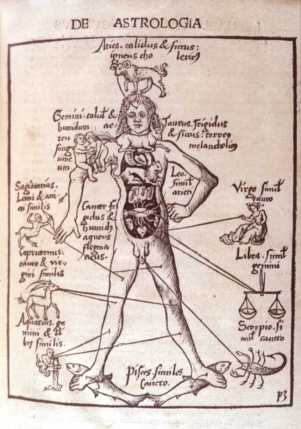
Thus, “Zodiac Man” was born as a handy guide to pinpointing general ailments and weaknesses in the body. Broadly, here is a summary of the correspondence between zodiac signs and those susceptible bodily parts and functions:

Aries – Head, eyes, adrenals

zodiac-1

Taurus – Neck, throat, shoulders, ears

Gemini – Lungs, nerves, arms, shoulders, fingers

Cancer – Chest wall, breasts

Leo – Heart, spine, upper back, spleen

Virgo – Abdomen, bowel, liver, gallbladder, pancreas

Libra – Lower back, buttocks, hips, kidneys, endocrines

Scorpio – Reproductive organs, pelvis, urinary bladder, rectum

Sagittarius – Thighs and lower legs

Capricorn – Knees; and bones and skin generally

Aquarius – Ankles, blood vessels generally

Pisces – Feet

So … thinking of your own star sign, do any of the weaknesses ring true? (Not that we believe such things today!)


Thanks for the Memory

memorypalaces_small

The 20th century philosopher, Gaston Bachelard, considered the house to be “one of the greatest powers of integration for thoughts, memories and dreams of mankind.”

Bachelard’s idea is really not a new one. In the Middle Ages, in that time prior to the invention of the printing press, and when access to books was very limited, the accurate recalling of huge chunks of information – even whole manuscripts – was not just an art but an essential skill for scholars who needed a reliable method of remembering information. And this method involved a house … of sorts.

Much earlier, Cicero, in his Rhetorica ad Herennium described a method of memory that was ‘locational’. That is, it involved the locating of specific things and ideas to be remembered within specifically-imagined rooms or architectural divisions in a ‘mind space’ (later known as the ‘memory palace’). Cicero’s method was revived in the monastic culture of the High Middle Ages with Hugh of St. Victor being a leading exponent in using architectural imagery to serve a mnemonic function. He, and others around the time, used as many of the senses as possible to support the mental impressions of objects, ideas, and entire texts that were to be placed in the memory palace for later retrieval. For example, different manuscripts might have had a different ‘feel’ or distinctive smell, and their contents may have reminded the scholar of an earlier experience, or even a friend. Inside the palace, different rooms served to house different categories of information and the scholar would ‘walk through the palace’ (of his mind), moving from the ‘general’ to the ‘specific’. With practice, no doubt, the ‘walk’ became quicker, more direct.

In addition to using such imagery for the purposes of remembering, it was in the medieval period, too, that the practice of finding associations between physical space and the spiritual space was distilled and enlarged. In part this was because the general populous was illiterate so that other things, besides words, needed to be able to be ‘read’ in order to convey information, specifically information of a religious nature. Thus, for example, the medieval cathedral was designed to be ‘read’ by the church goers with many things in the physical space being representational of something else in a ‘higher’ space. Every image in the stained glass windows, every carving on the great supporting columns, every leering gargoyle, told a story and taught a lesson. That is, sacred space, in the medieval period at least, was not just a space or place associated with divinity or religious worship but a vibrant representation of another even more vibrant spiritual reality.

This takes us back to our philosopher, Bachelard, who said that “Our soul is an abode. And by remembering ‘houses’ and ‘rooms’ we learn to abide within ourselves.” It’s an interesting idea but, as the average size of the Australian home has increased by around 50% in the last twenty years – from 169sq metres to 220 sq metres – I wonder if the physical edifice says more about our (external) desires and aspirations than about our souls.

Love is in the Air

medieval-love-letter

In a few days time, the hearts, chocolates and premium-priced roses will be eagerly snapped up by lovers and would-be lovers, keen to demonstrate their devotion to the object of their affection. And while the commercial aspect of Valentine’s Day is very much a modern phenomenon, the day itself has its origins in the Middle Ages.

True, very early foundations for the day can be found in the ancient Roman fertility Feast of Lupercalia which randomly paired young boys and girls in marriage; but it was the 14th century that gave us our current focus on romantic love. At that time, the West experienced a surge of interest in saints’ and martyrs’ legends. One very popular story was that of St Valentine, a priest of the 3rd century who defied the Roman Emperor Claudius II’s ban on the marrying of Christian couples, and proceeded to perform marriages in secret. For his efforts, St Valentine was executed in 278, and his feast day came to celebrated on 14th February.

As it happened, too, the medieval people (particularly in France and England) commonly believed that birds began their mating season on 14th February. In his Parlement of Foules (Parliament of Fowls) the great Geoffrey Chaucer recorded the belief for posterity with the words:

For this was sent on Seynt Valentyne’s day
Whan every foul cometh ther to choose his mate

And there it was: the amorous nature of the day was set … for better or worse.

New Year Nights, Gifts, and Knights

xmas-tree

Although our word “Christmas” comes from the Old English (10th century) term “Cristesmæsse”, the medieval practices and celebrations of the season were very different to our contemporary celebrations, and gift-giving was certainly not a feature. There’s some evidence, however, of gift-giving at New Year and one of the most interesting medieval stories that deals with the exchange of gifts is an Arthurian story, Sir Gawain and the Green Knight.

The story begins in Arthur’s court of Camelot where he and his knights are enjoying frivolous New Year games and gifts. The carefree atmosphere is shattered by the arrival of an unknown giant of a knight who is not only dressed all in green but also has skin of a green hue. Even his horse is green. Now, of course, in the broadest interpretation of this story opening, the “green knight” represents the intrusion of the natural world (and the “old religions”) into a Christian setting but there are more important lessons in this story.

Once the shock of his entrance into the King’s court has subsided, the Green Knight asks for a volunteer to cut off his head. Sir Gawain steps up to the challenge and removes the Green Knight’s head cleanly in one blow. To everyone’s surprise, however, the Green Knight bends down to pick up his own severed head and, propping it under his arm, continues to speak to the assembly. He reminds them that since “one good turn deserves another”, Sir Gawain is expected to seek him out at the same time next year so that he may remove Sir Gawain’s head.

The laws of chivalry require Sir Gawain to honour the request and so, in the biting winter of the following Christmas-New Year period, Gawain sets off on his quest.  His adventures en route to his destiny are too lengthy to describe here but what is really interesting about the fabulous Gawain is that, despite his honour and fortitude, he does eventually accept a talisman – a waist cord of green silk – that, while not allowing him to avoid his fate, will protect him from death. With such help, he still faces the Green Knight, still endures the strike of the axe, but his life is spared. Nevertheless, he must return (alive) to Arthur’s court with an obvious and an indelible scar on his neck. It is a bodily reminder of his human frailty. In addition, he decides to emphasise his lack of total courage by wearing the green cord as another sign of his imperfection. In support of his honesty, all the other Arthurian knights take to wearing green silk belts too.

In this New Year as we make all kinds of resolutions to be better than last year, I think that Gawain and the knights can teach us a valuable lesson about doing our best, honouring our commitments, acting with courage and behaving with dignity. But they can also remind us to accept that, despite our best intentions, we are only human; and our friends and family will love us, scars and all.

Kangaroo Court of Australia

Why rent a lawyer when you can buy a judge

Dally Messenger III

Social Integrity - Civil Celebrants - Politics and Current Affairs

Quodcumque - Serious Christianity

“Whatever you do, do it with your whole heart.” ( Colossians 3: 23 ) - The blog of Father Richard Peers SMMS, Director of Education for the Diocese of Liverpool

On Research

Age Concern New Zealand

Notes from the U.K.

Exploring the spidery corners of a culture and the weird stuff that tourist brochures ignore.

Zombie Salmon (the Horror Continues)

A blog about Horror fiction, Horror writing, and Horror criticism...a continuation of The Horror at Open Salon

Causeway Lit

An online literary journal

From my Mind

From My Mind: You can call this site as a personal blog or personal dairy: whatever it's I wanna call this site as my World. Because here, I post whatever it reaches my mind.

SHINE OF A LUCID BEING

Astral Lucid Music - Philosophy On Life, The Universe And Everything...

David Palethorpe

The thoughts, dreams and ideas of an insignificant speck of humanity in the Universe 😀

Ailish Sinclair

Stories and photos from Scotland

Unsophisticated Articles

A learning tool through experience

wake up and smell the humans

The website of Sean Crawley

The Reluctant Retiree

Stories from Garrulous Gwendoline - a baby boomer surviving retirement

The Immortal Jukebox

A Blog about Music and Popular Culture

KAGHAMAR

L'art de la Bible